The grout quantity formula with every term explained, worked for 600 by 600 porcelain with a 3 mm joint, plus the joint width and class UAE specifications use.
Grout quantity in kg per m2 is (L + W) divided by (L x W), multiplied by the tile thickness T, the joint width J and a density factor from the data sheet, with every dimension in millimetres. For 600 by 600 by 10 mm porcelain with a 3 mm joint and a factor of 1.6 that gives 0.16 kg per m2, so 850 m2 needs 136 kg before wastage. It is the formula grout manufacturers print on their data sheets and the one behind the calculators on this site. The sections below explain each term, show the arithmetic step by step, and set out which joint width and which EN 13888 class a UAE specification should carry.
What is the grout quantity formula?
Written out in full:
kg per m2 = (L + W) / (L x W) x T x J x density factor
where L and W are the tile length and width in mm, T is the tile thickness in mm, J is the joint width in mm, and the density factor is the bulk density of the mixed grout in kg per litre, taken from the data sheet.
The formula is nothing more than the volume of joint per square metre multiplied by what that volume weighs. Each tile owns one length of joint and one width of joint, because every joint is shared between two tiles. So the joint volume per tile is (L + W) x J x T, the tile occupies L x W of floor, and dividing the two gives joint volume per unit area. With all dimensions in millimetres the result comes out in litres per m2, since one millimetre of depth over one square metre is one litre. Multiplying by the density in kg per litre turns litres into kilograms.
Two consequences follow. The quantity rises in direct proportion to the joint width and to the tile thickness, so doubling either doubles the grout. And the quantity rises as the tile gets smaller, because small tiles have far more joint per square metre, which is why mosaics consume grout at several times the rate of large format porcelain.
What does each term mean on site?
L and W are the actual tile face dimensions, not the nominal size, though for a 600 by 600 porcelain the difference does not change the result at the second decimal place.
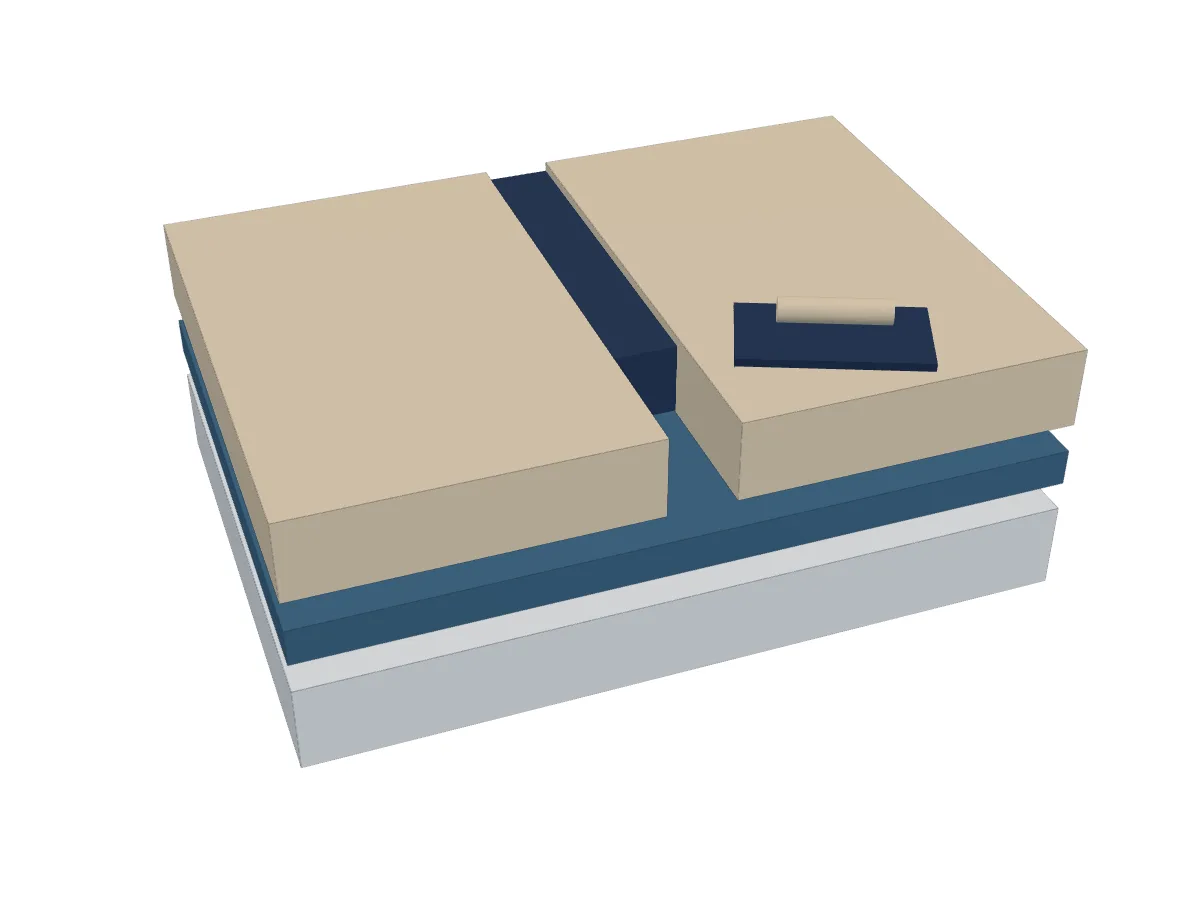
T is the tile thickness, and the formula assumes the joint is filled for the full depth of the tile. The model below shows the grout layer at the full 10 mm tile depth for that reason. In practice some adhesive rises into the bottom of the joint and some grout is lost to the sponge, and the two roughly cancel, so estimate on full depth and let the wastage line cover the rest.
J is the joint width the specification sets, not the spacer the tiler happens to have. If the specification says 3 mm, estimate at 3 mm and write 3 mm in the BOQ description, so a wider joint on site shows up as a quantity variation and not a shortage.
The density factor is the figure that changes between products. For the arithmetic in this guide we use 1.6, which is a representative figure for a cementitious grout. The actual factor for Ultracolor Plus, Fugabella Color or Kerapoxy is on the data sheet on each product page, and it should be taken from there before the number is priced.
Worked example: 600 by 600 by 10 mm porcelain with a 3 mm joint
The job is the same 850 m2 of 600 by 600 by 10 mm porcelain floor from our adhesive estimating guide, grouted with a CG2 WA cementitious grout at a 3 mm joint.
- L + W: 600 + 600 = 1,200 mm
- L x W: 600 x 600 = 360,000 mm2
- Divide: 1,200 / 360,000 = 0.003333 per mm
- Multiply by T: 0.003333 x 10 = 0.03333
- Multiply by J: 0.03333 x 3 = 0.1 litres per m2
- Multiply by the density factor: 0.1 x 1.6 = 0.16 kg per m2
- Net grout for 850 m2: 850 x 0.16 = 136 kg
- Wastage at 10 percent, as a separate line: 13.6 kg
- Total to order: 136 + 13.6 = 149.6 kg, call it 150 kg
Divide 150 kg by the pack size on the product page to get packs. If the grout comes in 5 kg packs, that is 30 packs. If it comes in a larger bag, the count drops accordingly and the rounding changes, so check the pack before the BOQ is issued.
Now the same tile at the other two joint widths UAE projects argue about. At 2 mm, step 5 becomes 0.03333 x 2 = 0.0667 litres per m2 and the result is 0.0667 x 1.6 = 0.107 kg per m2, or about 91 kg for 850 m2. At 5 mm, step 5 becomes 0.03333 x 5 = 0.1667 and the result is 0.267 kg per m2, or about 227 kg for 850 m2. A decision about joint width that looks like a design preference is a quantity decision too, and on an epoxy grout it is a cost decision.
For contrast, a 50 by 50 by 4 mm mosaic with a 2 mm joint: (50 + 50) / (50 x 50) = 100 / 2,500 = 0.04; times 4 is 0.16; times 2 is 0.32; times 1.6 is 0.512 kg per m2, more than three times the porcelain floor.

Tap the model to open the layers, then select the grout to see it filling the joint to the full 10 mm depth of the porcelain, which is the T the formula assumes.
2 mm, 3 mm or 5 mm: which joint width for the UAE?
The joint has two jobs. It absorbs the dimensional tolerance of the tiles, so that a run of tiles stays in line even though no two are exactly the same size, and it absorbs the day to day movement between tiles that the adhesive bed cannot take alone. A joint that is too narrow for either job cracks or spalls at the arris.
A 2 mm joint is the minimum for rectified porcelain laid indoors with a levelling system, where the tiles are ground to a tight tolerance and the floor is conditioned. It needs a grout whose data sheet allows a 2 mm minimum and a tiler who will fill it to full depth, because a 2 mm joint half filled is a dirt trap that cannot be cleaned.
A 3 mm joint is the UAE norm for rectified porcelain floors and walls and the figure the model above is built on. It gives room for tolerance, it suits every CG2 grout we hold, and it is wide enough to fill and tool properly in heat, when cementitious grout stiffens quickly.
A 5 mm joint, and wider, is for non rectified ceramics with a cushioned edge, for natural stone with sawn edges, for external terraces and pool surrounds where thermal movement is higher, and for textured slip resistant tiles whose edges are not straight enough to meet at 3 mm. Check the maximum joint width on the grout data sheet too. weberjoint at CG1 is made for joints from 1 to 6 mm, and Fugabella Color runs from 2 to 20 mm.
One rule: grout joints are not movement joints. A grouted floor still needs movement joints at the spacing the specification sets, every three to four metres on a facade, and those are formed with a sealant on a backer or a prefabricated profile such as the ones under Profilpas movement and stairnosing, never grouted through.
CG2 WA or RG: cementitious or epoxy grout?
EN 13888 classifies grouts the same way EN 12004 classifies adhesives. CG is cementitious grout, class 1 normal and class 2 improved, with W for reduced water absorption and A for high abrasion resistance. RG is reaction resin grout, which in practice means epoxy. ANSI A118.3 is the American standard that covers epoxy grouts and adhesives, and some products carry both.
A CG2 WA grout is the right specification for general interior floors and walls, for wet areas over a waterproofing membrane, and for most external paving. It is cleaned with water, it is priced per kilogram well below epoxy, and it is the class the model above shows. A CG1 grout is adequate for dry interior walls where abrasion and water are not in play.
An RG grout is for joints that see standing water, chemicals, food acids or aggressive cleaning: swimming pools, spa tanks, commercial kitchens, laboratories, hospitals and food plants. It is stain proof, chemically resistant and does not need sealing, and it is also the grout for glass mosaic in a pool where a cement grout would stain through. It costs more per kilogram and more per hour to apply and clean, which is why the joint width decision above matters most on epoxy work. The quantity formula is identical. Only the density factor changes, and it comes from the epoxy data sheet.
Which grouts do UAE specifications name?
The grouts we hold at the three branches, with the class shown on each product page:
- Ultracolor Plus, Mapei, CG2 WA, fast setting, water repellent and formulated against efflorescence. The default cementitious grout on UAE porcelain floors.
- Keracolor FF, Mapei, CG2 WA, for fine joints.
- Kerapoxy, Mapei, RG, the pool and kitchen epoxy, with Kerapoxy CQ at RG for easier cleaning on large floors and Kerapoxy Easy Design at RG for decorative joints.
- Fugabella Color, Kerakoll, CG2 WA, a resin cement grout in fifty colours for joints from 2 to 20 mm.
- weberjoint, Weber, CG1, for 1 to 6 mm joints, and weberjoint Deco, CG2 WA and ANSI A118.7.
- Morcemcolor Plus Flexible, Pidilite Puma, CG2 A W, manufactured in the UAE with short lead times.
- Laticrete Spectralock Pro Premium Grout, an epoxy grout to ANSI A118.3 for projects written to American standards.
Each brand hub lists the rest of its range with classes: Mapei, Kerakoll, Weber, Pidilite Puma and Laticrete, and the complete Mapei list is under Mapei tile adhesives and grouts.
How do you put grout into the BOQ?
A grout item in a BOQ should describe the class, the joint width and the tile it serves, and give the quantity in kilograms with the wastage on its own line. A description that prices cleanly reads: "Cementitious grout to EN 13888 class CG2 WA, 3 mm joints, to 600 by 600 by 10 mm porcelain floor tiles, 850 m2, filled to full tile depth. Mapei Ultracolor Plus, Kerakoll Fugabella Color or equal approved." Then the quantity line at 136 kg and the wastage line at 10 percent, each with its rate.
The Mapei grout calculator runs the formula above for any tile size, thickness and joint width with the Mapei factors built in, and each product page carries a consumption calculator and a BOQ clause for the same purpose. Colour is a separate line if more than one shade is used, because packs are not interchangeable between colours. Contractors and resellers who buy grout to specification can open a trade account for project pricing and credit on approval, and the authorisation letters for consultant submittals are on the credentials page.
What to send us: the tile sizes, thicknesses, joint widths and areas, or the BOQ itself, on WhatsApp, and the quotation comes back with the kilograms worked from the data sheet factor, wastage as its own line, pack counts by colour, and the technical data sheets attached. If the specification names the grout class, send that line and we price every brand we hold against it.
Questions this guide answers
What is the formula for grout quantity per square metre?
Kilograms per m2 equals (L + W) divided by (L x W), multiplied by the tile thickness T, the joint width J and a density factor from the grout data sheet, with L, W, T and J all in millimetres. For 600 by 600 by 10 mm tiles with a 3 mm joint and a factor of 1.6 the result is 0.16 kg per m2 before wastage.
Why does a mosaic need so much more grout than a large tile?
Because the formula divides the joint perimeter by the tile area, and small tiles have far more joint per square metre. A 50 by 50 by 4 mm mosaic with a 2 mm joint works out at about 0.51 kg per m2, more than three times the 0.16 kg per m2 of 600 by 600 porcelain with a 3 mm joint.
Is a 2 mm grout joint acceptable in the UAE?
Only for rectified porcelain indoors, laid with a levelling system, and only where the grout data sheet allows a 2 mm minimum. The joint has to absorb the tile's dimensional tolerance as well as movement, and a 2 mm joint leaves no room for either. Most UAE specifications settle on 3 mm for rectified tiles and 5 mm or more for non rectified tiles, stone and external work.
When should the grout be an epoxy RG rather than a cementitious CG2?
Where the joint will see standing water, chemicals, food acids or heavy cleaning: swimming pools, commercial kitchens, laboratories, hospitals and food plants. An RG grout to EN 13888 is stain proof and chemically resistant and does not need sealing. For general floors, walls and wet areas a CG2 WA cementitious grout is adequate and costs less per kilogram and per hour to apply.
Does the density factor change between grouts?
Yes. The factor is the bulk density of the mixed grout in kilograms per litre and it varies with the binder, the fillers and the colour pigments. Cementitious and epoxy grouts carry different figures, and two cementitious grouts from different manufacturers can differ. Take the factor from the data sheet of the grout you specify rather than reusing one from another product.