A step by step method for turning a BOQ area into tile adhesive bags, with trowel notch, bed thickness, back buttering, wastage and pallets, worked for Dubai.
To estimate adhesive bags from a BOQ you need four numbers: the tiled area in m2, the bed thickness the trowel and tile size will produce, the manufacturer's consumption in kg per m2 per mm, and the bag weight. Multiply area by thickness by consumption, add wastage as a separate line, divide by the bag weight and round up to whole bags, then to whole pallets if the site can store them. The method below walks through 850 m2 of 600 by 600 porcelain on a 10 mm notched trowel, the most common tiling package a UAE quantity surveyor prices, and shows the two places where estimates most often go wrong: the bed thickness and the rate.
What does the BOQ give you and what is missing?
A tiling BOQ normally gives the area by location and the tile size and type. It sometimes gives the substrate and almost never gives the trowel, the bed thickness or the back buttering rule. Those three are what set the adhesive quantity, so the estimator has to supply them from the specification, the data sheet or site practice.
Floor and wall areas should be separated because walls take a thinner bed and a different adhesive class. Skirting is usually measured in linear metres and needs converting to area at the skirting height. Where the specification already names the adhesive class, usually C2 TE or C2 TE S1 to EN 12004 for porcelain, note it now because it decides which data sheet rate to use later.
Which trowel notch gives which bed thickness?
A notched trowel combs the adhesive into ridges of the notch depth with gaps between them. When the tile is bedded and tapped down the ridges spread into the gaps, so the finished bed is well under the notch depth. On a flat screed the working rule is about half the notch depth, more where the screed is uneven or the tile has warpage that the bed has to fill.
| Trowel notch | Bedded thickness, approximate | Typical use |
|---|---|---|
| 6 mm | 3 mm | Ceramic wall tiles up to 300 by 600 |
| 8 mm | 4 mm | Ceramic and small porcelain floors |
| 10 mm | 5 mm | Porcelain up to 600 by 600 on a flat screed |
| 12 mm | 6 mm | Porcelain 600 by 600 and larger, uneven screeds |
| 15 mm and 20 mm | 8 mm and above | External full bed, stone, very large slabs |
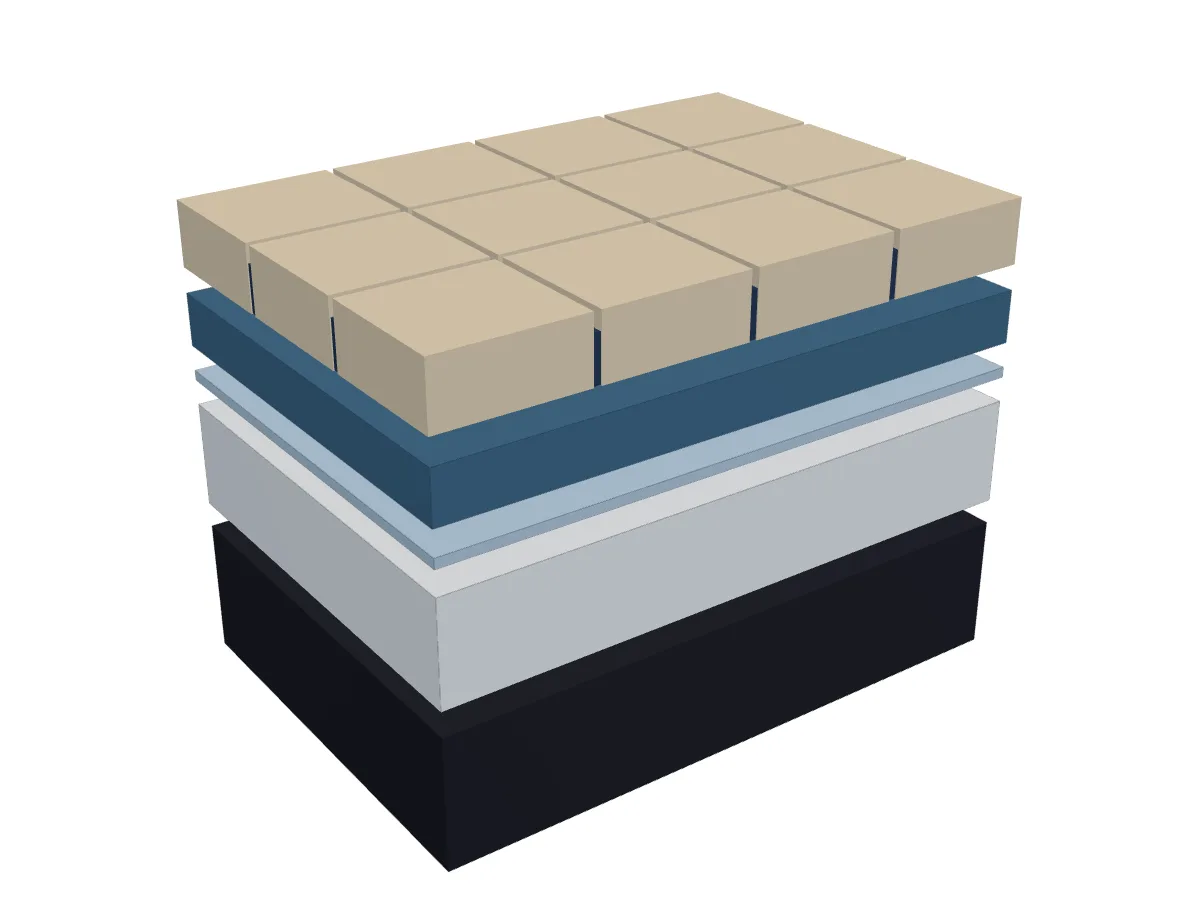
The model below shows a 6 mm bed, which is the figure most UAE specifications land on for large format porcelain once back buttering is added to a 10 mm trowel. Always estimate on the bedded thickness and state the trowel you assumed in the BOQ note, so that a change of trowel on site shows up as a change of quantity rather than a shortfall.
Why is back buttering a separate allowance?
Back buttering means spreading a thin skim of adhesive across the back of the tile with the flat edge of the trowel before bedding it into the combed bed. It does two things. It fills the texture and the hollows in the tile back so the ridges make full contact, and it adds between 1 and 2 mm of effective thickness to the bed.
It is required for tiles 600 by 600 and larger, for every external tile, and wherever the specification calls for high contact. The usual targets are at least 80 percent solid bed contact for internal dry areas and at least 95 percent for wet areas and outside, with no voids at the edges and corners. A bed that falls short of these figures is where hollow sounding tiles and edge cracking start, and no adhesive class fixes a void.
For the estimate, treat back buttering as its own millimetre or two added to the bedded thickness. On a 10 mm trowel that takes a 5 mm bed to 6 mm. Carry it as a stated assumption in the BOQ note rather than rounding the rate up silently, so the quantity surveyor can see why the kilograms are higher than a flat trowel calculation would give.

Tap the model to open the layers, then select the adhesive bed to see the 6 mm this estimate is built on, sitting between the primer on the screed and the 10 mm porcelain.
How do you read the coverage figure on the data sheet?
Manufacturers publish consumption in one of two forms. The first is kg of powder per m2 per mm of bed thickness, which is the form the formula wants. The second is kg per m2 for a named trowel, for example a figure "with a 10 mm trowel", which already contains the manufacturer's assumption about bedded thickness. Convert the second form to the first by dividing by the bedded thickness that trowel gives, and note that the manufacturer's assumption may differ from yours.
Three points of care. The figure is for dry powder, not mixed adhesive, so it maps straight onto bags. Lightweight adhesives such as Ultralite S1 at C2TE S1 and Ultralite S2 Flex at C2E S2 have a lower density, so their kg per m2 per mm is lower than a standard adhesive at the same thickness and a lighter bag covers more area. Compare adhesives on m2 per bag at the specified bed, not on price per bag. And two part systems, such as Kerabond T mixed with Isolastic, quantify the powder and the latex separately.
Coverage rates belong to the product and change with reformulation, so they are not printed here. For the actual figure see the data sheet on the product page of the adhesive you specify: Keraflex Maxi S1 Zero at C2TE S1, H40 Gel at C2 TE S1, Pegoland Flex at C2 TE S1 or webercol Pro at C2TE. Each product page carries a consumption calculator that takes area and bed thickness and returns bags from the manufacturer's rate, and a BOQ clause written for the quantity surveyor to paste.
Worked example: 850 m2 of 600 by 600 porcelain on a 10 mm notch
The job: 850 m2 net floor area of 600 by 600 by 10 mm porcelain on a cured sand and cement screed, internal, specified as C2 TE S1 to EN 12004. For the arithmetic we use 1.3 kg per m2 per mm, a typical figure for a standard cementitious adhesive. Replace it with the figure on the data sheet of the adhesive you specify before the number goes into a BOQ.
- Area from the BOQ: 850 m2
- Bedded thickness from a 10 mm notch: 5 mm
- Back buttering allowance: 1 mm, giving an effective bed of 6 mm
- Consumption per m2: 6 mm by 1.3 kg per m2 per mm = 7.8 kg per m2
- Net adhesive: 850 m2 by 7.8 kg per m2 = 6,630 kg
- Wastage at 10 percent, as a separate line: 663 kg
- Total to order: 6,630 kg + 663 kg = 7,293 kg
- Bags at 25 kg: 7,293 divided by 25 = 291.7, so 292 bags
Without the wastage line the same job is 6,630 divided by 25 = 265.2, so 266 bags. The 26 bag difference is what goes missing when wastage is left out.
The rate is the other sensitivity. If the data sheet for the adhesive chosen says 1.5 kg per m2 per mm rather than 1.3, the net figure becomes 6 mm by 1.5 = 9.0 kg per m2, and 850 m2 by 9.0 = 7,650 kg. That is 1,020 kg more than the first calculation, or 41 extra bags before wastage. A difference of 0.2 in the rate moves the order by more than the wastage line does, which is why the rate must come from the sheet of the product actually being supplied and not from memory.
How much wastage should the estimate carry?
Between 5 and 10 percent, stated as its own line and never folded into the consumption rate. The two numbers move for different reasons. Consumption depends on trowel, tile and substrate and can be audited against the data sheet. Wastage depends on how the site runs and is a judgement.
In the UAE the biggest driver of wastage is heat. A combed bed that skins before the tile goes down has to be scraped off and discarded, and a bucket mixed at the start of a shift in July is unusable sooner than the data sheet pot life suggests. Add the adhesive on cut tiles at the perimeter, the last few kilograms in every bucket, and bags that split or get wet in storage. For conditioned interiors with an experienced crew, 5 percent holds. For summer work, external work, small rooms with many cuts or a crew new to the product, carry 10 percent.
Showing wastage separately also protects the contractor: if it is struck out, the record shows the net quantity was correct.
How do pallet quantities change the order?
Cementitious adhesives in the UAE ship on pallets, and full pallets are cheaper to move and faster to load than loose bags. Pallet counts vary by product, so the quotation states the count for the bag you are buying. If, for illustration, the pallet holds 48 bags, the 292 bags from the worked example are 6 full pallets, which is 288 bags, plus 4 loose bags. Most sites either round up to 300 bags and hold the extra against the next zone, or take 6 pallets and call off the balance with the grout.
Bags must sit off the floor, under cover and out of the sun, and cementitious adhesive has a shelf life printed on the bag, so order to the storage the site has and schedule top ups. For phased projects the better pattern is to price the whole BOQ quantity and call it off by floor or by zone. Our three branches, in Al Quoz Industrial Area 4 in Dubai, Mussafah Industrial Area 40 in Abu Dhabi and Al Sajaa Industrial Area in Sharjah, hold the fast moving adhesives in pallet quantities, so a call off placed before 3 pm is delivered the next working day.
Which adhesive is the estimate assuming?
The class drives both the thickness and the rate, so the estimate is only as good as the product behind it. For 600 by 600 porcelain on an internal screed the specification is normally C2 TE S1, back buttered. The stock answers across the brands we hold are Keraflex Maxi S1 Zero, H40 Gel and Pegoland Flex at C2 TE S1, with Laticrete 254 Platinum to ANSI A118.4 and A118.15 where the project is written to American standards. For a terrace or a facade step up to S2 with webercol Flex at C2 TE S2 or Ultralite S2 Flex, and outside move to a 12 mm trowel, which raises the kilograms per m2.
The full ranges are under Mapei tile adhesives and grouts, Kerakoll tile adhesives and grouts and the Mapei and Weber brand hubs, each product with its class and data sheet. Contractors and resellers pricing BOQs regularly should open a trade account for project pricing and credit on approval, and the authorisation letters for consultant submittals are on the credentials page.
What to send us: the BOQ, or the tile schedule with areas, tile sizes and substrate, on WhatsApp, and the quotation comes back with the bag count worked from the data sheet rate, wastage as its own line, pallets stated, and the technical data sheets attached. If the specification names the class, send that line too and we price every brand we hold against it.
Questions this guide answers
How many bags of tile adhesive do I need per square metre?
There is no single figure. Multiply the bed thickness in millimetres by the consumption in kg per m2 per mm on the data sheet, then divide the bag weight by that number. A 6 mm effective bed at 1.3 kg per m2 per mm uses 7.8 kg per m2, so a 25 kg bag covers about 3.2 m2 before wastage. Thinner beds and lightweight adhesives cover more.
Does a 10 mm notched trowel give a 10 mm adhesive bed?
No. The trowel leaves 10 mm ridges with gaps between them, and when the tile is bedded and tapped the ridges collapse into the gaps. The finished bed is roughly half the notch depth, about 5 mm for a 10 mm trowel on a flat screed, more where the screed is uneven or the tile is warped. Estimate on the bedded thickness, not the notch.
Should wastage be built into the consumption rate?
Keep it as a separate line. A rate with wastage hidden inside cannot be checked against the data sheet, and the two numbers move for different reasons. Consumption depends on trowel, tile and substrate. Wastage depends on heat, cut tiles, mixing discipline and site storage. Five percent is reasonable for conditioned interiors and ten percent for summer or external work.
Do lightweight tile adhesives need fewer bags?
They need fewer kilograms for the same bed thickness because the powder is less dense, so a lighter bag covers more area. Compare adhesives on square metres per bag at the specified thickness, not on price per bag. The data sheet consumption figure, in kg per m2 per mm, already reflects the lower density, so the same formula applies.
Can Lapiz Blue check the adhesive quantity in my BOQ before quoting?
Yes. Send the BOQ or the tile schedule with areas, tile sizes and substrate by WhatsApp or email and the quotation shows the bag count worked from the data sheet rate, with wastage as its own line, rounded to bags and pallets. The technical data sheets for every product quoted come with it, and project pricing is available against the BOQ.