How open time and pot life collapse on UAE facades and terraces above 60 degrees, and what to change in adhesive class, batch size, joints and curing in summer.
Outside in the Gulf a tiled surface reaches 60 degrees and more by early afternoon, and the adhesive feels it before the tile does. Open time, the window in which the combed bed still wets the back of a tile, can shrink from the 30 minutes on the data sheet to under ten. Pot life, the time the mix stays workable in the bucket, shortens the same way. The answer is to buy that time back: work early and in shade, dampen the substrate, mix smaller batches, choose an E class adhesive with S2 deformability, and detail movement joints every 3 to 4 m so the facade can expand without taking the tiles with it.
Why does external tiling fail more often in summer than in winter?
Three things happen to a cementitious adhesive as the temperature rises. The cement hydrates faster, so the mix stiffens sooner. Water evaporates from the surface of the combed bed, so a skin forms that the tile cannot wet through. And a dry, absorbent substrate pulls water out of the adhesive from below at the same time. All three are worse on a render facing west at 3 pm than on a screed indoors.
The failure is not dramatic on the day. The tile is placed on a bed that has skinned, the fixer beats it in, it looks fixed. A back check shows the ridges intact and dry with a print of the tile on top rather than a solid transfer. Six months later, after a summer of expanding at noon and contracting at night, the bond that was never complete lets go. Hollow tiles on a UAE facade are usually a summer fixing problem, not a product problem.
What happens to open time when the substrate is at 60 degrees?
EN 12004 measures open time at 23 degrees and 50 percent relative humidity. A standard adhesive must still bond a tile placed 20 minutes after combing; an E class adhesive at 30 minutes. Neither figure holds on a surface at 60 degrees. As a planning assumption every 10 degree rise roughly halves the window, so 30 minutes on the sheet becomes something like 7 on a hot render, and less in a wind.
The practical consequence is the area the fixer combs before placing tiles. Indoors in winter that might be a square metre and a half. On an exposed terrace in August it is what can be tiled, beaten in and checked in three to four minutes, often two tiles of 600 by 600. Anything more has skinned by the time the tile reaches it.
Skinning can be tested. Touch a ridge of the combed bed: if adhesive transfers to the finger it is open; if the ridge is dry, scrape it off and comb fresh. The supervisor should be making that test every half hour.
How does pot life differ from open time, and why does it matter for batches?
Pot life is the time in the bucket. A 25 kg bag mixed at 23 degrees stays workable for the period on the sheet. In August the same bag mixed with hose water that has sat in the sun, in a bucket on a hot slab, may stiffen in a fraction of that time. Adding water to a stiffening mix brings back the consistency and destroys the bond strength and deformability it was bought for. It is the most common site error we see on external work.
The fix is batch size. Mix only what the crew can comb and tile within the shortened pot life, use cool water, store the bags in shade and keep the mixing station out of the sun. A crew that mixes three bags at a time in winter should be mixing one in summer.

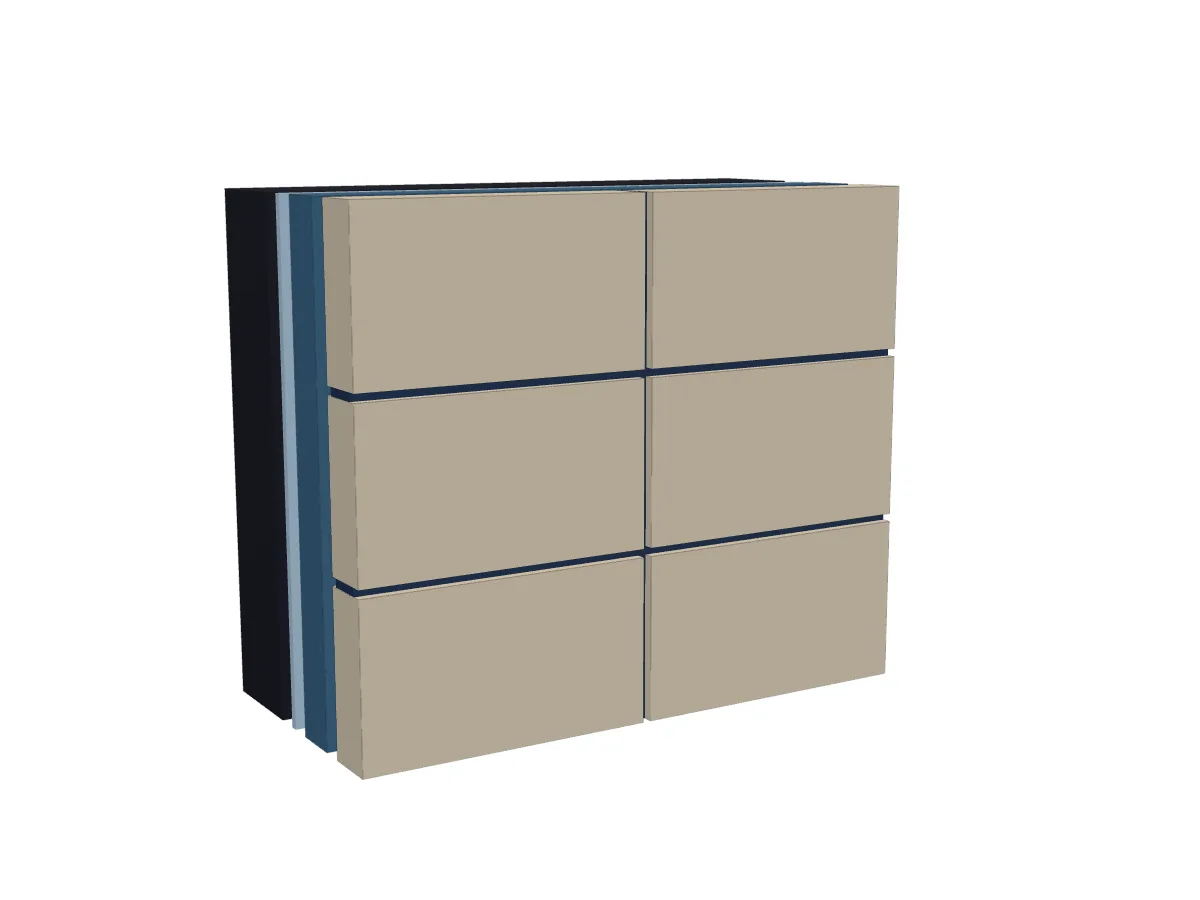
Tap the model to open the layers and see the 8 mm back buttered S2 bed, the porcelain, and the movement joints the facade needs every 3 to 4 m.
Which adhesive class for a facade or terrace in the UAE?
The specification for external tiling in the Gulf is a C2 adhesive with two letters after it: E for extended open time, because the window is the problem, and S2 for deformability, because tile and substrate expand at different rates every day and the adhesive is the only layer that can take the difference. T for slip resistance is wanted on a wall.
In stock at Lapiz Blue General Trading LLC, a tile adhesive supplier in Dubai with branches in Al Quoz Industrial Area 4, Mussafah Industrial Area 40 and Al Sajaa Industrial Area:
- Mapei: Ultralite S2 Flex, ISO 13007-1 C2E S2, the first choice for terraces and facades. Keraflex Maxi S1 Zero, ISO 13007-1 C2TE S1, for sheltered external floors. The full range is on the Mapei tile adhesives and grouts page.
- Kerakoll: H40 Tech, C2 TE S2, and H40 Gel, C2 TE S1. Top Latex , C2 E S2, is the route where a two component adhesive is specified.
- Weber: webercol Flex, C2TES2, manufactured in the region.
- Pidilite Puma: Pegoland Superflex, C2 TE S2, manufactured in the UAE.
- Laticrete: Laticrete 254 Platinum, to ANSI A118.4 and A118.15, where the project is written to the American standards.
S1 is the floor, not the target. A facade in full sun, a terrace over a waterproofed deck, a pool surround or any tile over 600 by 600 outside gets S2.
How should the crew change its working method in summer?
The method changes more than the material. These points decide whether the back check passes.
- Work early and shaded. Start at first light and stop when the surface passes about 40 degrees, which on a west elevation in August can be before 10 am. Elevations that have been in the sun all day are tiled after sunset only once they have cooled.
- Wet the substrate. Dampen the render or screed the evening before and again an hour before fixing, so the surface is damp with no standing water when the adhesive goes on. A dry render in July takes the water out of a 6 mm bed in minutes.
- Comb small, check often. Comb two or three tiles ahead, place, beat in, and lift one tile in ten to look at the back. Outside the target is 100 percent contact with no dry ridges and no voids.
- Back butter every tile, whatever its size. The skim on the tile back fills the ridges and keeps water out of the bed.
- Protect the work. Cover fresh work with damp hessian or shade net for 24 hours so the adhesive cures with its water.
Where supply and installation are wanted together, application is by our sister company Sixty Newton Technical Services LLC.
Where do movement joints go, and when is mechanical fixing required?
A rendered facade and a porcelain tile expand at different rates, and the facade as a whole moves against its structure. Movement joints let that happen. Outside they go every 3 to 4 m in both directions, at the perimeter of every field, at every change of substrate or direction, over every structural joint and at every storey line. The joint runs through the tile, the adhesive and the render or screed, and is filled with a prefabricated profile or a closed cell backer rod and an exterior grade sealant such as Mapesil LM, classed F-EXT-INT-CC to EN 15651-1. Grout never crosses it. The Profilpas Balcony and Terrace Profiles cover the edge and drip details on a terrace.
Mechanical fixing is the second rule. Above a height set by the adhesive manufacturer, and above a tile weight the manufacturer also sets, external wall tiles are fixed with stainless steel clips, undercut anchors or a rail system as well as the adhesive, so a bond failure cannot become a falling tile. The figure is on the data sheet or in a technical note and varies between products and tile sizes. Ask for it with the quotation and put it in the method statement.
Why white or light adhesive under light stone?
A grey cementitious adhesive under a light marble, limestone or translucent porcelain shows through as a shadow, uneven wherever the bed thickness varies. Water in the bed also carries the colour of the cement up into the stone as it dries, and on a terrace in the sun that can set as a permanent stain. Specify the white version under any stone or tile lighter than mid grey and under any translucent stone. Most of the adhesives above come in white; the quotation states which.
Worked example: planning a 220 m2 terrace in August
A terrace of 220 m2 in 600 by 600 by 10 mm porcelain on a bonded screed over a waterproofed deck, in August, with a C2E S2 adhesive. The quantities and the batching are two separate sums.
Quantities. Read the consumption rate for a 10 mm notch with back buttering from the data sheet on the product page; call it R kg per m2. Total = 220 x R x 1.10 for wastage. To show the arithmetic, use 5 kg per m2 as a stand in for the sheet figure, not a quoted rate: 220 x 5 = 1,100 kg; plus 10 percent = 1,210 kg; at 25 kg a bag = 48.4, so 49 bags. Replace 5 with the figure on the sheet.
Batching. Read the pot life from the sheet, stated at 23 degrees, and halve it for August as the planning assumption. If the sheet gives 4 hours, plan on 2. A two fixer crew back buttering 600 by 600 tiles with regular back checks lays about 8 m2 an hour in summer conditions, so one batch should cover no more than 2 hours x 8 m2 = 16 m2. At the stand in rate of 5 kg per m2 that is 80 kg, so mix no more than three bags at a time and preferably two. A one bag mix is 5 m2, around 40 minutes of work, the safe batch on the hottest days.
Programme. With a working window from 5 am to 10 am the crew tiles 5 x 8 = 40 m2 a shift. 220 / 40 = 5.5, so six early shifts for one crew or three for two crews working from opposite ends towards the central movement joint. Grouting follows in the same early window once the adhesive has reached the strength on the sheet.
How do you cure, protect and grout external tiling in the heat?
A cementitious adhesive needs its mixing water for the first day to reach the strength it is classed on, and on an exposed terrace that water is gone in an hour unless the work is covered. No foot traffic until the data sheet period has passed.
Grouting follows the same logic. Dampen the joints so the grout does not flash dry against hot porcelain, work in the early window, and clean off within the time on the sheet because residues set fast in the heat. For external joints a CG2 WA grout is the minimum; Ultracolor Plus, classed CG2FWA, is the stock answer and its fast set suits the short window. Movement joints are sealed last, after the grout has cured.
The manufacturer authorisation letters for consultant submittals are on the credentials page, and every quotation carries the current data sheet and safety data sheet.
What to send us. Send the terrace or facade area, the tile size and weight, the substrate and the elevation, or simply the BOQ, on WhatsApp. The quotation comes back with the quantities checked against the data sheet and the sheets attached.
Questions this guide answers
What is the difference between open time and pot life?
Pot life is how long the mixed adhesive stays workable in the bucket after water is added. Open time is how long a combed bed on the substrate still wets the back of a tile before it skins. Both are measured at 23 degrees on the data sheet and both shorten sharply in Gulf summer heat, open time first and most.
Which adhesive class is right for a facade or terrace in the UAE?
A C2 adhesive with E for extended open time and S2 for deformability, so a C2 TE S2 or C2 E S2 to EN 12004. Examples in stock are Mapei Ultralite S2 Flex, Kerakoll H40 Tech, Weber webercol Flex and Pidilite Puma Pegoland Superflex. S1 is the minimum for sheltered external floors; S2 is the specification for anything in full sun.
How far apart should movement joints be on external tiling?
Every 3 to 4 m in both directions on facades and terraces, at every change of substrate, at the perimeter and over every structural joint. The joint runs through the tile, the adhesive and the render or screed, and is filled with a prefabricated profile or a backer rod and an exterior grade sealant, never with grout.
Can external tiling be done in a UAE summer at all?
Yes, with the method changed. Work from first light to mid morning or after sunset, shade the elevation, dampen the render, mix smaller batches, comb only what can be tiled in a few minutes, check the back of a tile often, and protect the finished work from direct sun for the first day. The quantities of adhesive do not change; the batching does.
When can external tiling be grouted in summer?
When the adhesive has reached the strength the data sheet gives for foot traffic and grouting, which is stated at 23 degrees. Heat speeds the set but the bed under a back buttered 600 by 600 tile cures from the edges in, so wait the full stated period, grout early in the day, and dampen the joints so the grout does not flash dry.