What counts as large format porcelain, why the adhesive must be S1 or S2, and how to back butter for full contact on UAE floors, walls and terraces.
Large format porcelain starts at 600 by 600 mm and runs up to 1200 by 2400 mm slabs and 6 mm gauged panels. A tile that size spans more substrate, bridges more thermal and drying movement, and leaves more room for voids under it, so the adhesive must be deformable: S1 as the minimum on a cured screed indoors, S2 on facades, terraces, heated screeds and anything that moves. The slab is also back buttered: a thin skim of adhesive on the back of the tile, combed the same way as the bed, so the two layers knit into one solid bed with 95 percent contact indoors and 100 percent outside and in wet areas.
What counts as large format porcelain?
The trade threshold is 600 by 600 mm. At that size and above, four things change at once. The tile covers more substrate per piece, so any hollow in the screed becomes a void under the tile rather than a joint. The tile is heavier, so slip on a wall matters more. The tile is stiffer than the adhesive and the screed, so differential movement concentrates at the bond line. And the back of a pressed porcelain tile is rarely flat: there is a bow of a millimetre or so over 1200 mm that a single combed bed cannot fill.
Three sizes come up in UAE tenders:
- 600 by 600 and 600 by 1200 mm pressed porcelain, 9 to 11 mm thick.
- 1200 by 1200 up to 1200 by 2400 mm slabs, 10 to 12 mm thick, used for lobbies, lift cars and feature walls.
- Gauged porcelain panels, 6 mm or 6.5 mm thick and up to 1600 by 3200 mm, used for cladding, counters and wall linings where weight is the constraint.
Any of these is large format when specifying the adhesive. The 6 mm panel is the hardest case: thin enough to flex, so a void under it becomes a crack under a loaded trolley.
Why does a large tile need an S1 or S2 adhesive?
EN 12004 and ISO 13007-1 classify cementitious adhesives as C1 or C2 for bond strength, then add letters for behaviour: T for slip resistance, E for extended open time, F for fast setting, and S1 or S2 for deformability. S1 means the cured adhesive deflects at least 2.5 mm in the standard transverse test before it breaks. S2 means at least 5 mm.
Deformability lets the adhesive absorb the difference in movement between a porcelain tile that barely moves and a screed that shrinks as it dries, a slab that deflects under load, or a facade that heats to 60 degrees by noon and cools at night. A rigid C2 adhesive under a 1200 mm slab passes all of that strain to the weakest interface, usually the back of the tile: a hollow sound, then a lifted corner, then a cracked slab.
The working rule we give consultants:
- S1 on a cured, bonded cement screed indoors, for tiles from 600 by 600 up to about 1200 by 1200 mm.
- S2 on terraces, facades and pool surrounds, on heated or unbonded screeds, on plywood, metal or existing tiles, and under gauged panels and slabs over 1200 by 1200 mm.
The stock S1 answer is Keraflex Maxi S1 Zero, an ISO 13007-1 C2TE S1 adhesive whose extended open time matters on a warm slab. For S2, Ultralite S2 Flex, ISO 13007-1 C2E S2, is the one we quote for slabs and panels. The rest of the range is on the Mapei tile adhesives and grouts line page.
How much contact is enough, and what does back buttering add?
The target is 95 percent of the tile back in contact with adhesive indoors, and 100 percent outside, in wet areas and under 6 mm panels. Lift a tile ten minutes after bedding and look at the back. Ridges of adhesive with dry channels between them is a failed check.
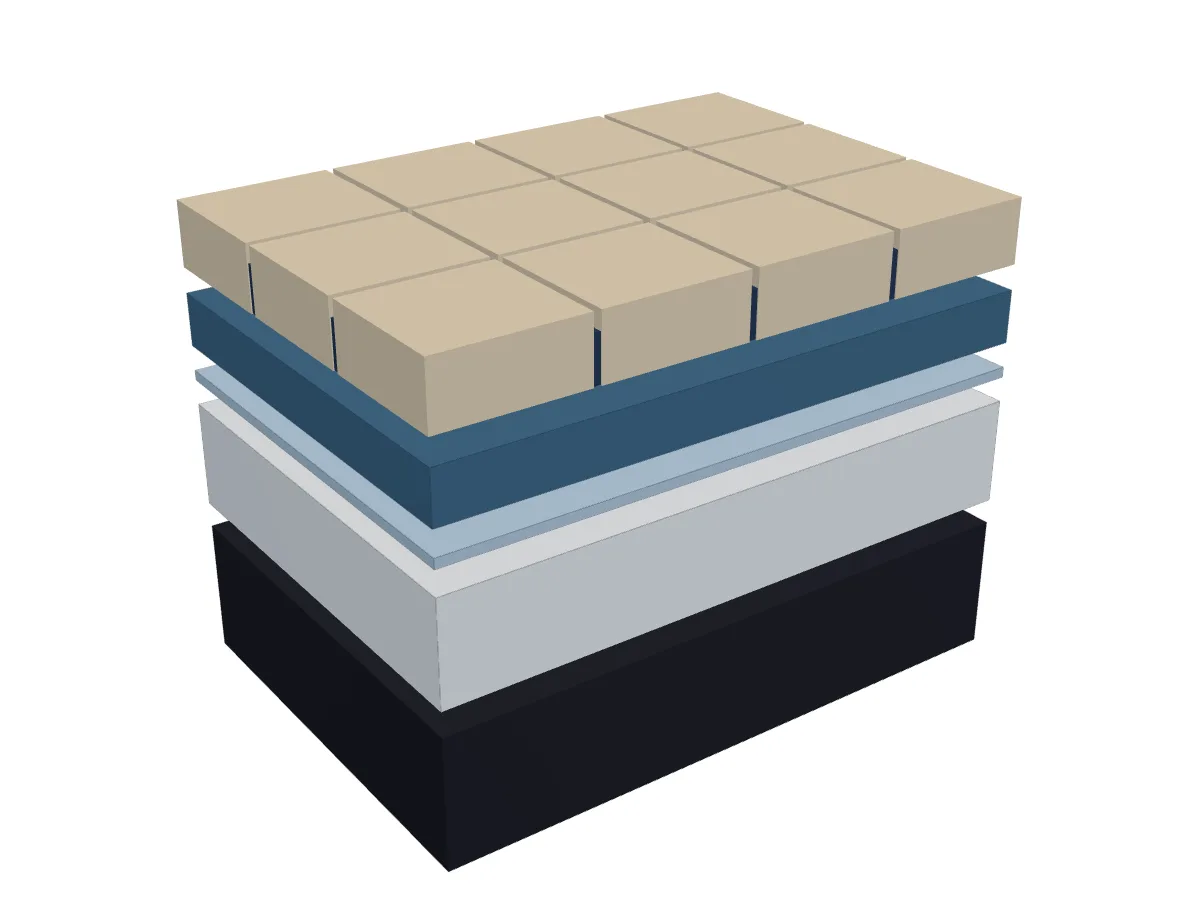
Back buttering is how you reach the figure. The fixer combs the bed with the notched side of the trowel, then skims the back of the tile with the flat side, filling the texture and any bow, and on a slab combs the back lightly in the same direction as the bed. When the tile is beaten in, the ridges collapse into the skim and the two layers become one solid bed. Comb in straight lines, not swirls, so air can escape along the channels.

Tap the model to open the layers and see where the 6 mm adhesive bed and the back buttered porcelain sit between the screed and the grout.
Which trowel and bed thickness for each slab size?
Bed thickness is set by the trowel, and the trowel by the tile. Too thin and the back butter has nothing to collapse into. Too thick and the adhesive slumps and the tile floats.
- 600 by 600 mm pressed porcelain: a 10 mm square notch on the substrate, a 3 mm skim on the tile. Finished bed around 5 to 6 mm.
- 600 by 1200 and 1200 by 1200 mm: a 12 mm U or half round notch, back buttered. Finished bed 6 to 8 mm.
- Slabs to 1200 by 2400 mm and gauged panels: a 12 to 15 mm notch with wide, rounded channels, often called a Euro notch, combed in one direction, with the panel back combed the same way with a 6 mm notch. Finished bed 6 to 10 mm.
Check the maximum bed thickness on the data sheet; most C2 S1 adhesives are rated to 10 or 15 mm in one application. Where the screed is out by more than 3 mm over 2 m, correct it with a levelling compound, not with the adhesive.
How do you control lippage on 1200 by 600 and gauged panels?
Lippage is the step between adjacent tile edges. A rectified slab has a square edge, so half a millimetre shows under a low window. The causes are an uneven screed, uneven bed thickness, and tiles moving as the adhesive wets out.
A clip and wedge levelling system holds the tile edges flush while the adhesive sets. Klic Level uses a threaded clip and cap that tightens by hand, and Fix Level is the wedge version for fixers who prefer pliers. Both go into the adhesive under the joint before the next tile is laid, two per edge on a 1200 mm side, and are snapped off once the adhesive has hardened, leaving the spacer in the joint under the grout. The rest of the Profilpas spacers and tools are in Tools and Accessories.
A levelling system does not replace a flat screed. It pulls tiles into plane across the bed, so it only works if the bed is thick enough to compress.
What changes when the slab is laid in Gulf heat?
Open time is the window after combing during which the adhesive still wets the tile back. The data sheet figure is measured at 23 degrees; on a Dubai screed in June the surface can be above 40 degrees in the shade and the open time can halve or worse. The adhesive skins, the tile sits on a crust, and the back check shows clean ridges.
Practical measures:
- Use an E class adhesive, which EN 12004 defines as an open time of at least 30 minutes under test conditions.
- Dampen an absorbent screed before combing, with no standing water, so it does not pull the water out of the adhesive.
- Comb no more than the crew can tile in ten minutes, and check the back of a tile every few square metres.
- Start early, shade the work and keep the bags out of the sun.
Where the client wants supply and application together, installation is by our sister company Sixty Newton Technical Services LLC.
How do you handle a 1200 by 2400 slab and what joint does it need?
A 1200 by 2400 slab at 10 mm weighs around 65 kg and a 6 mm gauged panel at 1600 by 3200 about 70 kg. Neither can be carried by hand without flexing. Panels are moved on a frame with vacuum suction cups, two fixers to a frame, lifted vertically from the crate and lowered onto the bed in one motion, and the frame lets them lift the panel again to inspect the back. Slabs are scored on a rail and snapped, or wet cut with a continuous rim diamond blade.
Grout joints for rectified porcelain: 2 mm is the practical minimum indoors, 3 mm is the UAE norm and our assumption in quantities, and 5 mm outside so the joint can take movement and the grout can be compacted. A CG2 WA grout such as Ultracolor Plus, classed CG2FWA, suits the interior joints. Movement joints run through the tile, the adhesive and the screed at every structural joint, at the perimeter, and at 8 to 10 m centres indoors; the Profilpas Movement and Stairnosing range covers the prefabricated option.
Worked example: adhesive for 300 m2 of 1200 by 600 slabs
Take a lobby of 300 m2 in 1200 by 600 by 10 mm porcelain on a cured sand and cement screed, bedded with a 12 mm notched trowel and back buttered.
- Read the consumption for a 12 mm notch with back buttering, in kg per m2, from the data sheet on the product page; call it R. For Keraflex Maxi S1 Zero, see the data sheet on the product page linked above.
- Multiply by the area. 300 m2 x R kg per m2 = 300R kg.
- Add 10 percent wastage, the figure we use for back buttered large format. 300R x 1.10 = 330R kg.
- Divide by the pack size on the data sheet and round up to whole bags.
To see the arithmetic with a number in it, suppose the sheet gave 6 kg per m2, a stand in for the exercise and not a quoted rate. Then 300 x 6 = 1,800 kg; plus 10 percent = 1,980 kg; at 25 kg a bag = 79.2, so 80 bags. Replace 6 with the sheet figure and the rest follows. A lightweight S2 such as Ultralite S2 Flex yields differently per bag, so recalculate rather than substituting bag for bag.
Which products do we quote for large format in the UAE?
Lapiz Blue General Trading LLC is a tile adhesive supplier in Dubai with stock across three branches: Al Quoz Industrial Area 4 in Dubai, Mussafah Industrial Area 40 in Abu Dhabi and Al Sajaa Industrial Area in Sharjah. For large format the shortlist is:
- Mapei: Keraflex Maxi S1 Zero, ISO 13007-1 C2TE S1, for S1 floors; Ultralite S2 Flex, ISO 13007-1 C2E S2, for slabs, panels and exteriors.
- Kerakoll: H40 Gel, C2 TE S1; H40 Tech, C2 TE S2, for slabs; H40 Extreme, an R2 T reactive adhesive for metal and resin substrates.
- Weber: webercol Flex, C2TES2, made in the region.
- Pidilite Puma: Pegoland Superflex, C2 TE S2, manufactured in the UAE.
- Laticrete: Laticrete 254 Platinum, which meets ANSI A118.4 and A118.15, where the project is written to the American standards.
Trade pricing and project pricing against a BOQ are available through a trade account, and every quotation carries the current data sheet for each line.
What to send us. Send the tile size and thickness, the substrate, the area in m2 and whether it is inside or outside, or simply the BOQ, on WhatsApp. The quotation comes back with the quantities checked against the data sheet and the sheets attached.
Questions this guide answers
What size tile counts as large format porcelain?
Anything from 600 by 600 mm upwards is treated as large format when specifying the adhesive. That includes 600 by 1200 pressed porcelain, 1200 by 1200 and 1200 by 2400 slabs at 10 to 12 mm, and gauged porcelain panels at 6 mm thick up to 1600 by 3200 mm. All of them need a deformable adhesive and back buttering.
Is an S1 adhesive enough for 1200 by 600 porcelain indoors?
On a cured, bonded cement screed indoors, yes. A C2 TE S1 adhesive such as Keraflex Maxi S1 Zero, back buttered to 95 percent contact, is the standard specification. Move to S2 for terraces, facades, heated or unbonded screeds, timber, metal or existing tiles, and for slabs larger than 1200 by 1200 mm or 6 mm gauged panels.
Do I have to back butter every large format tile?
Yes. Back buttering fills the texture and the slight bow on the back of a large tile so the combed bed and the tile skim merge into one solid bed. Without it the tile sits on ridges with dry channels between them, which is where hollow sounds, lifted corners and cracked slabs begin. Lift a tile early on each day to check the contact.
What grout joint width should rectified porcelain slabs have?
Two millimetres is the practical minimum indoors for rectified porcelain, three millimetres is the UAE norm and the figure used in grout quantities, and five millimetres outside so the joint can take movement and the grout can be compacted. Movement joints run through tile, adhesive and screed at the perimeter, at structural joints, and at 8 to 10 m centres indoors.
Can a levelling system fix an uneven screed?
No. A clip and wedge system such as Klic Level or Fix Level holds adjacent tile edges flush while the adhesive sets, which removes lippage from bed variation and from tiles moving as they wet out. It cannot pull a tile into plane across a screed that is out by more than 3 mm over 2 m. Correct that with a levelling compound first.