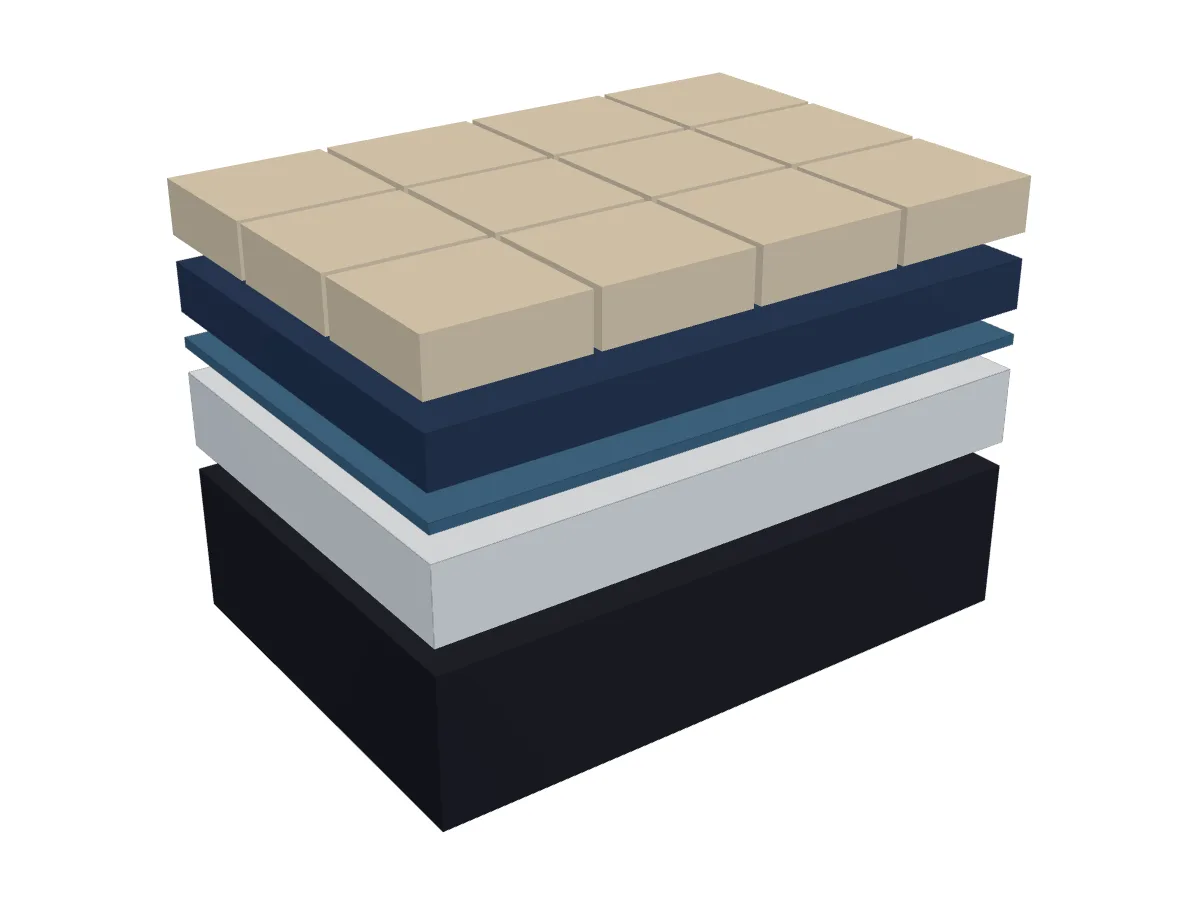
What a UAE pool or water tank needs under and between the tiles: tested shell, waterproof render, two coat membrane, S1 or epoxy adhesive and RG epoxy grout.
A pool or a water tank is a wet area that never dries, so every layer between the concrete and the tile has to hold up under permanent immersion and the chemistry of the water: chlorine in a swimming pool, salt in a seawater or balance tank, sometimes both. The sequence is fixed. The shell is water tested first. A waterproof render shapes it. A two coat flexible cementitious membrane goes over the render with tape at every joint and corner. Then a C2 TE S1 cementitious adhesive or an R2 epoxy adhesive, and an RG epoxy grout to EN 13888 in the joint, cured for the days the data sheet gives before the pool is filled.
Why is the shell water tested before any finish goes on?
The membrane, the adhesive and the grout are finishes, not the structure's waterproofing. A reinforced concrete shell is expected to hold water on its own, and the only way to know it does is to fill it and measure. The usual test fills the shell to operating level, lets the concrete absorb water for a day or two, then holds the level for seven days with the drop measured against an evaporation reference. A shell that loses water is repaired first: cracks injected, honeycombing cut out and filled, joints and penetrations detailed with a waterstop or sealant.
Tile over an untested shell and, when the pool leaks, the first thing stripped out to find the leak is the tiling. That is the cost of the whole finish, twice.
What do the waterproof render and the two coat membrane do?
The render does two jobs. It shapes the shell to the tolerances the mosaic needs, which a shuttered concrete face never meets, and it gives the membrane a sound, even, absorbent surface. It is a polymer modified cement and sand render, less permeable than a plain mix, applied in two coats where the thickness is over 15 mm and cured damp before the membrane goes on.
The membrane keeps the water out of the render and shell behind the tiles. In a pool it is a two component flexible cementitious membrane to EN 14891, applied in two coats, the second across the first, to the total thickness on the data sheet. At every construction joint, change of plane, corner and pipe a tape or collar is set into the first coat wet, so the joint that moves is bridged by something that stretches.
The Mapei system is Mapelastic Smart, classed CM O1, with Mapeband in the corners and joints; the rest of the range is on the Mapei waterproofing line page. Weber offers weberdry 116 FX with weber Band, Kerakoll Aquastop Flex with Aquastop 120 tape, and Laticrete the Laticrete 9235 Waterproofing Membrane. All are stocked by Lapiz Blue General Trading LLC, a waterproofing supplier in Dubai with branches in Al Quoz Industrial Area 4, Mussafah Industrial Area 40 and Al Sajaa Industrial Area. Confirm on both sheets that the adhesive is listed as compatible with the cured membrane.
Cementitious S1 or epoxy adhesive: which one under mosaic?
Both are used in UAE pools and the choice turns on the tile, the water and the substrate.
A cementitious C2 TE S1 adhesive to EN 12004 is the economical route for porcelain and ceramic pool tiles and ceramic mosaic. Its sheet must state permanent immersion, it must be deformable because the shell moves as it fills and empties, and it must be back buttered to full contact because a void behind a pool tile fills with water and becomes the point where the tile lets go. Use the white version under glass or light mosaic. Keraflex Maxi S1 Zero, ISO 13007-1 C2TE S1, and Kerakoll H40 Gel, C2 TE S1, are the stock answers.
An epoxy adhesive takes over where the cementitious one is at its limit. Glass mosaic has no absorbency and a smooth back, so the mechanical key a cement adhesive relies on is weak. Salt and heavily chlorinated water attack cement paste over time. A steel or GRP tank, or an old tiled pool being overlaid, gives a cement adhesive nothing to bond to. In each case an R2 reactive adhesive is specified: Kerapoxy Adhesive, R2T, or Laticrete Latapoxy 300 Adhesive, or Kerakoll H40 Extreme, R2 T. The epoxy is also impermeable, so it protects the membrane behind it. It costs several times more per m2, so it is specified where needed.

Tap the model to open the layers, from the tested shell through the render and two coat membrane to the adhesive bed and the epoxy grouted mosaic.
Why must the grout in a pool be an RG epoxy?
EN 13888 classifies grouts as CG, cementitious, or RG, reaction resin. A CG2 grout, even with W for reduced water absorption, is a cement paste with pores. Under water the pores fill, chlorine attacks the hydrated cement, and the joint softens, erodes and discolours. Salt crystallises in the pores and lifts the surface. Body fats and sunscreen stain a cement joint in a season. The result is the regrouting cycle most UAE pool operators accept as normal.
An RG epoxy grout has no pores. It is a resin and hardener with a filler, cures by reaction rather than drying, does not absorb water, resists the acids and alkalis used in pool treatment and needs no sealing. The trade off is handling: the pot life is short, the material is viscous, and the wash off must happen within the window on the sheet or the haze is permanent.
The RG grouts in stock: Kerapoxy, RG, the standard specification; Kerapoxy CQ, RG, with a quartz filler that cleans off mosaic more easily; Laticrete Spectralock Pro Premium Grout for the American standards; Kerakoll Fugalite Color, RG; Weber weberepox Easy, to ANSI 118.3; and Pidilite Puma Morcemcolor Epoxi, classed R2T / RG, which both bonds and grouts.
What do chlorine and salt water do to a cementitious joint?
Chlorine in a pool is held as hypochlorous acid and hypochlorite, balanced by keeping the pH between about 7.2 and 7.6. When the pH drifts low the water turns acidic and dissolves the calcium hydroxide that binds a cement paste. When the dosing is heavy the chloride attacks the paste and, through a failed membrane, the reinforcement. Shock dosing after a closure is the worst case for a cement joint.
Salt water pools and seawater balance tanks add sodium chloride at a concentration cement was never designed for. Salt is carried into the pores as water moves in and out of the joint, and as the joint dries at the water line or during a drain down it crystallises and breaks the paste apart. Sulphates in seawater attack the cement a second way, forming expansive compounds inside the paste.
An epoxy joint is indifferent to all of this within the limits on its sheet, which lists the chemicals and concentrations tested. For a pool it must include sodium hypochlorite, for a seawater pool sodium chloride, and for a plant room the acids used for pH correction. Check the list rather than the word resistant.
How are balance tanks and plant rooms different from the pool itself?
The pool is what everyone looks at and the balance tank is where the system fails. It receives the overflow, holds the water the pumps draw, and in most UAE systems is where the chlorine and acid are dosed, so the concentration at the dosing point is many times that in the pool. It is dark and warm, never drained for cleaning, and inspected only when the plant room floods.
The specification for a balance tank is the pool system with no economies: water test, render, two coat EN 14891 membrane with tape at every joint and around every pipe, epoxy adhesive, RG epoxy grout, and an access detail so the tank can be inspected. Pipe penetrations are the detail to draw: a collar in the membrane, the pipe sealed to the collar with a compatible sealant, the tile cut neatly around it rather than packed with grout.
How long before the pool is filled, and how is immersion resistance stated?
Every layer has a cure before permanent immersion on its data sheet, and the longest governs. Cementitious membranes commonly need the longest, the cementitious adhesive next, the epoxy grout the least. All are stated at 23 degrees; a shaded pool in a Dubai winter is close to that, a plant room in summer is hotter and cures faster. Run the figures in parallel from the date each layer was finished and take the latest.
Immersion resistance is stated in one of two ways: the product is described as suitable for swimming pools and tanks, or there is a water absorption result after immersion and a list of chemicals tested at concentration. The first is the minimum, the second is what a consultant can defend. A sheet silent on immersion is not a pool product.
Where supply and installation are wanted together, application is by our sister company Sixty Newton Technical Services LLC, which keeps the installation records for the handover file.
Worked example: epoxy grout for 150 m2 of 25 by 25 mm mosaic
Grout quantities follow one formula, the one behind the Mapei grout calculator:
Grout in kg per m2 = (L + W) / (L x W) x T x J x 1.6
where L and W are the tile length and width in mm, T the grout depth in mm, J the joint width in mm, and 1.6 the grout density in kg per litre. For mosaic the grout fills the full tile thickness, so T is the mosaic thickness.
Take 150 m2 of 25 by 25 mm glass mosaic, 4 mm thick, with 2 mm joints:
- (L + W) = 25 + 25 = 50
- (L x W) = 25 x 25 = 625
- 50 / 625 = 0.08
- x T = 0.08 x 4 = 0.32
- x J = 0.32 x 2 = 0.64
- x 1.6 = 1.024 kg per m2
- x 150 m2 = 153.6 kg
- Add 10 percent for mosaic wastage and wash off: 153.6 x 1.10 = 168.96, so 169 kg.
Divide by the pack size and round up to whole packs, because an opened pack of epoxy does not keep. The mosaic drives the figure: 25 mm tiles have twenty four times the joint length per m2 of a 600 by 600 tile. At 6 mm thick instead of 4, T becomes 6 and the total 1.536 kg per m2, or 253 kg for the same pool.
What must the data sheet say before you submit it?
For a consultant submittal each sheet needs to answer five questions in writing. The classification: EN 14891 for the membrane, EN 12004 C2 S1 or R2 for the adhesive, EN 13888 RG for the grout, or the ANSI equivalent. Suitability for permanent immersion and swimming pools, stated. Chemical resistance as a list with concentrations, including sodium hypochlorite and, for seawater, sodium chloride. The cure before filling, at the stated temperature. And compatibility with the layer below, confirmed on at least one sheet at each interface.
Every quotation carries the current technical and safety data sheets, and the manufacturer authorisation letters for the submittal are on the credentials page.
What to send us. Send the pool and tank areas, the tile type and size, the joint width and whether the water is fresh or salt, or simply the BOQ, on WhatsApp. The quotation comes back with the membrane, adhesive and grout quantities checked against the data sheets and the sheets attached.
Questions this guide answers
Can a pool be grouted with cementitious grout instead of epoxy?
It can be, and it is the reason most UAE pools are regrouted within a few years. A cementitious CG2 grout absorbs water, chlorine attacks the cement paste, and salt crystallises in the pores. An RG epoxy grout to EN 13888 is impermeable, chemically resistant and does not need sealing, so it is the specification for immersed joints.
Which adhesive is used for glass mosaic in a swimming pool?
Either a white C2 TE S1 cementitious adhesive back buttered to full contact, or an R2 epoxy adhesive such as Kerapoxy Adhesive or Latapoxy 300 Adhesive where the mosaic is glass, the water is salt or heavily chlorinated, or the substrate is a steel or GRP tank. The epoxy route also lets the same material grout the joints.
How long after tiling can a pool be filled?
Only after every layer has reached the cure the data sheet gives before permanent immersion, and the longest figure governs. Cementitious membranes and adhesives commonly need longer than the epoxy grout. The figures are stated at 23 degrees; a cool plant room cures slower than a shaded pool. Fill slowly and check the water chemistry before the first dose of chlorine.
Does a balance tank need the same system as the pool?
It needs more. A balance tank sees the same water as the pool with the chlorine dosed directly into it, it is dark, it is never drained for cleaning, and nobody sees a failure until the plant room floods. Specify the two coat membrane with tape at every joint, an epoxy adhesive and an RG epoxy grout, and insist on the water test before tiling.
What must the data sheet say for a pool specification?
For the membrane, EN 14891 and permanent immersion. For the adhesive, EN 12004 C2 S1 or R2 and suitability for pools. For the grout, EN 13888 RG, chemical resistance to chlorine and, for seawater pools, to salt. For every layer, the cure before filling and the compatibility with the layer below. A sheet that is silent on immersion is a no.