How to choose an epoxy floor for a UAE warehouse, plant room or kitchen by thickness: 300 micron coatings, 2 to 4 mm self levelling, 6 mm plus mortar.
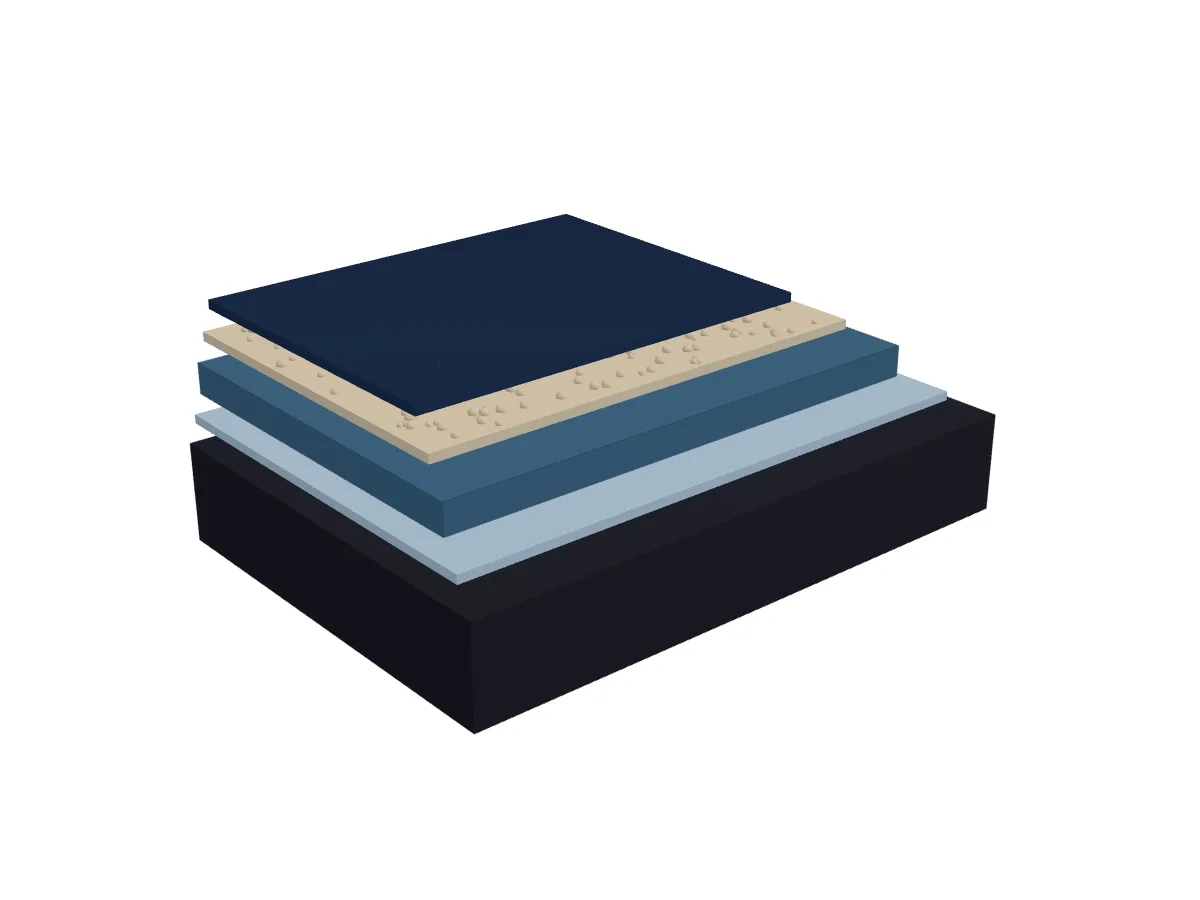
Choose an epoxy floor by the thickness the duty needs, not by the product name. A roller applied coating at around 300 microns seals and colours a slab that sees foot traffic and light trolleys. A self levelling epoxy at 2 to 4 mm gives a seamless, cleanable floor for warehouses, plant rooms and kitchens with forklift and pallet truck traffic. An epoxy mortar at 6 mm and more takes impact, point loads and a slab that is already damaged. All three sit on the same stack: a prepared slab, an epoxy primer, the body coat, an optional quartz broadcast and a top coat. This guide takes a specifier through each layer and the decision at each one.
Why does thickness decide the system?
Epoxy is a binder. A coat of it on its own is a few hundred microns thick and follows every ridge of the concrete under it. Add fine fillers and it flows to find its own level at two to four millimetres. Add graded quartz at several times the weight of the resin and it becomes a mortar, trowelled at six millimetres and more, that behaves like a hard screed.
The thicker the layer, the more load it spreads, the more impact it absorbs and the more it hides in the slab beneath. A 300 micron coating on a forklift aisle wears through at the turning points within a year; a 6 mm mortar in a dry store that only sees foot traffic is money spent for nothing. So the decision starts with the duty: what runs on the floor, what is spilled on it, how it is cleaned and what the slab is like today.
What has to happen to the slab before any epoxy goes down?
Most resin floor failures in the UAE are preparation failures. Three things must be true before the primer is opened.
The surface must be sound and open. Laitance, curing compounds, old paint and oil come off, and the pores of the concrete are exposed so the primer can get in. Diamond grinding is the norm for a slab in reasonable condition, shot blasting or planing for a contaminated or very hard trowelled one.
The slab must be strong enough. A pull off test gives the figure the resin maker asks for, usually a minimum surface tensile strength of 1.5 N/mm2 for a coating. A slab that fails needs the weak layer ground off, or a cementitious repair, first.
The slab must be dry. Epoxy is a vapour barrier, and a slab that is still drying out, or sits on grade without a working damp proof membrane, lifts the resin in blisters within weeks. Test with a hygrometer box or relative humidity probes drilled into the slab. Where the programme cannot wait, a moisture tolerant epoxy primer or a cementitious moisture suppressant goes down first, within the limit on its data sheet.
Which primer, and why does the stack fail without it?
The primer is the thinnest layer in the stack and the one most often cut from a tender. It penetrates the open pores of the ground concrete, binds the last of the dust, seals the surface so the body coat does not pinhole from escaping air, and gives the body coat a compatible surface to bond to.
For a dry, prepared slab the standard primer is a two part solvent free epoxy such as Primer SN A+B, classified under EN 13813 as a synthetic resin screed material. Under a self levelling body coat it is usually broadcast lightly with quartz while wet to give a key. Primer MF (a+b) is the alternative where the slab holds more moisture than a standard primer tolerates; check the limit on the sheet. In the Weber system the matching primer is weberfloor EPO Prime. Keep primer and body coat from one manufacturer so the intercoat adhesion and the recoat window are tested together and one warranty covers the stack.

Tap the model to open the layers, drag to turn the section, and tap a layer to read what fills it and the thickness it is drawn at.
Coating, self levelling or mortar: which do you specify?
The model shows the self levelling version with a 3 mm body coat. The three systems share the slab, the primer and the top coat; what changes is the body coat.
300 micron coatings
Two roller applied coats at roughly 150 microns each. The coating seals the concrete, stops dusting and gives a cleanable coloured surface for foot traffic, hand pallet trucks and light rubber tyred vehicles. Use it in dry stores, back of house corridors and the service areas of a plant room. Water based epoxies such as Mapefloor I 500 W and Mapecoat Universal are the common UAE choices because they go down in occupied buildings with low odour. In the Weber range weberfloor EPO Coat RAL 7040 is an epoxy floor coating supplied in RAL 7040, a light grey.
2 to 4 mm self levelling
A pigmented epoxy with fine filler, poured, spread with a pin rake and spike rolled to release air. It levels over small irregularities and gives a smooth, seamless floor that carries forklifts and pallet trucks without the tyres printing through. Two millimetres is the minimum under wheeled traffic; three to four where the slab is uneven or the loading heavier. Mapefloor I 300 SL ME is the self levelling epoxy in the Mapei range made for the region; for a conductive floor in an electronics or data area ask for the Mapefloor I 360 AS sheet.
6 mm plus mortar screeds
Epoxy binder mixed with graded quartz to a trowellable mortar, laid at 6 to 12 mm with a seal coat over it. It takes steel wheels, dropped tools, point loads and thermal shock from hot washdown, and it can relevel a damaged slab. Mapefloor EP 19 ME is the epoxy mortar grade in the Mapei line, for loading docks, workshops and heavy process areas. Where the thickness is wanted with a matt, cementitious finish that tolerates damp and heat, the alternative is a cementitious polyurethane such as Mapefloor CPU+/MF, classified under EN 13813 as CT C50 F15 and HACCP certified.
When do you broadcast quartz and when do you add a polyurethane top coat?
The two are not alternatives. The broadcast changes the texture; the top coat protects the colour.
A broadcast is dry quartz in a graded size such as Quartz 1.2 ME, thrown into the wet body coat until the surface is covered. Once cured, the loose sand is swept and vacuumed off and a seal coat locks the remaining grains. The result is a slip resistant floor with build. Specify it wherever the floor is wet in use: kitchen production, washdown bays, plant rooms with condensate, entrance ramps. The body coat data sheet gives the broadcast rate.
Epoxy yellows in ultraviolet light and chalks under glazing or outdoors. Where the colour matters, and in any car park, showroom with glass walls or rooftop plant area, a two part aliphatic polyurethane top coat such as Mapefloor Finish 450 ME keeps the colour and gives a harder, more scratch resistant surface. The top coat is also where a matt or satin finish is set and where a fine anti slip aggregate gives a lighter texture than a full broadcast.
How do you match the system to the room?
Warehouses. Self levelling epoxy at 2 to 3 mm in the aisles, with a mortar at the dock levellers where forks and trailer ramps strike the floor.
Plant rooms. Self levelling epoxy at 2 to 3 mm with a broadcast around pumps, chillers and water treatment, and a coved skirting so there is no joint at floor level for water to sit in. Check the chemical resistance table against the actual fluids: glycol, water treatment acids and alkalis, diesel near generators, hydraulic oil.
Kitchens. Food safety inspection in the UAE expects a seamless, coved, cleanable floor: a broadcast self levelling epoxy at 3 to 4 mm, or a cementitious polyurethane where hot washdown is routine, because epoxy softens under sustained heat and polyurethane cement does not.
Car parks. The deck moves, is wet and sees sun at the ramps and top level. A rigid epoxy cracks with it. Specify a flexible polyurethane deck system such as Mapefloor PU 410, classified under EN 13813 and EN 1504-2, with a broadcast on ramps and an aliphatic top coat on exposed decks.
Chemical exposure. Read the resistance table against concentration and contact time, not the chemical name alone; where a standard epoxy falls short, a novolac epoxy or a vinyl ester is the answer.
Laticrete and AkzoNobel also bring flooring resins into the UAE; see the Laticrete flooring and AkzoNobel flooring lines.
How much material does a 400 m2 plant room need?
Take a 400 m2 plant room at 2 mm self levelling epoxy over a primer. The arithmetic is the same for every product; the rate comes from the data sheet on the product page, not from this article.
Step 1. Area: 400 m2.
Step 2. Thickness: 2 mm.
Step 3. Rate. A self levelling epoxy is quoted in kilograms per square metre per millimetre. For the arithmetic take 1.6 kg per m2 per mm, the order a filled epoxy sits at because its mixed density is about that. Confirm the figure for Mapefloor I 300 SL ME on its page before ordering.
Step 4. Body coat: 400 × 2 × 1.6 = 1,280 kg.
Step 5. Wastage. Mixing losses and material left in the drums run at about 10 per cent on a floor this size: 1,280 × 1.10 = 1,408 kg, rounded up to whole kits using the kit size on the product page.
Step 6. Primer. If the primer sheet gives 0.3 kg per m2, then 400 × 0.3 = 120 kg, and the same allowance gives 132 kg.
Step 7. Broadcast and top coat, if specified, are taken from their own sheets; the top coat is quoted per coat and two coats are the norm.
What goes in the submittal and who installs it
A resin floor submittal needs the data sheet and safety data sheet for every layer, a method statement covering preparation, moisture testing, priming, body coat, broadcast and top coat with recoat windows at UAE temperatures, the chemical resistance table, the manufacturer system warranty naming the applicator, and the distributor authorisation. Our authorisations are on the credentials page and come with the quote.
Application is by our sister company Sixty Newton Technical Services LLC, which installs resin flooring to the manufacturer method; where the main contractor has its own applicator we supply the material and the technical support. Resin systems are ordered against a project with the lead time stated in writing, and Mapei flooring systems and Weber resins are handled from the Al Quoz branch in Dubai. Trade pricing and credit accounts open through the trade account route, and the epoxy flooring supplier page lists the full range across Mapei and the other brands we hold.
What to send us: the room schedule with areas, the duty for each room, the thickness specified and, where there is one, the BOQ. Send it on WhatsApp to the Dubai desk and the quote comes back with the data sheets attached.
Questions this guide answers
What thickness of epoxy floor does a warehouse need?
A warehouse with forklift and pallet truck traffic needs a self levelling epoxy at 2 to 3 mm over a primed, prepared slab. Dock levellers and areas where forks strike the floor need an epoxy mortar at 6 mm or more. A 300 micron coating is only enough for dry stores with foot traffic and hand trolleys.
Can epoxy be applied to a new concrete slab in the UAE?
Only once the slab has dried to the moisture limit on the primer data sheet, usually tested with a hygrometer box or in slab relative humidity probes. Epoxy is a vapour barrier and a damp slab lifts it in blisters. Where the programme cannot wait, a moisture tolerant epoxy primer or a cementitious moisture suppressant goes down first.
Does an epoxy floor need a polyurethane top coat?
It needs one wherever the floor sees daylight, because epoxy yellows and chalks under ultraviolet light. Car parks, showrooms with glazing and rooftop plant areas should always have an aliphatic polyurethane top coat. In a basement plant room the top coat is optional, but it still gives a harder, easier to clean surface.
What is the difference between a self levelling epoxy and an epoxy mortar?
A self levelling epoxy is pigmented resin with fine filler that is poured and finds its own level at 2 to 4 mm, giving a smooth glossy floor. An epoxy mortar is resin mixed with graded quartz and trowelled at 6 to 12 mm. The mortar takes impact, point loads and hot washdown and can rebuild a damaged slab.
Is epoxy suitable for a car park floor?
A rigid epoxy cracks with the deck and yellows on exposed levels. Car parks need a flexible polyurethane deck coating system that bridges movement, with a quartz broadcast on ramps for grip and an aliphatic top coat on decks that see the sun. Mapefloor PU 410 is classified under EN 13813 and EN 1504-2 for this duty.