How thick a self levelling compound goes in one pass, the flatness LVT and large format tile need, and when fibre reinforcement matters on UAE floors.
A self levelling compound goes down between 3 and 10 mm in one pass for most products, with thin finishing products that feather towards 1 mm and thick bed products that reach 30 or 40 mm, and the data sheet of the product you buy sets the exact range. Fibre reinforcement matters when the substrate is weak, cracked, timber or otherwise able to move under the compound, because the fibre holds the layer together where a plain compound would crack and telegraph through a resilient finish. This guide covers flatness, preparation and primer, thickness, pumping, fibre, the EN 13813 class on the bag, curing, and the bag count for a 180 m2 floor on a UAE site.
What flatness do LVT and large format tile actually need?
The British screed standard BS 8204 grades surface regularity as the maximum gap under a 2 metre straightedge: SR1 is 3 mm, SR2 is 5 mm and SR3 is 10 mm. A sand and cement screed laid well reaches SR2. LVT, sheet vinyl and rubber show every ripple, ridge and pinhole through a 2 to 3 mm finish, so they need SR1 and a closed, smooth surface, and many flooring manufacturers write a tighter figure into their own sheets. Large format porcelain, 600 by 600 mm and above, needs a flat substrate for a different reason: the adhesive bed must stay within the 3 to 6 mm its EN 12004 class is tested at, and a 5 mm hollow across a tile means either a thick unclassified bed or lippage at the joint.
The self levelling compound is the layer that closes the gap between what the screed delivers and what the finish needs. It does not create the level, the screed does that; it corrects the last few millimetres of flatness. On a UAE site the screed often curls at the bays and carries laitance from fast drying in the heat, so the regularity is measured with a straightedge and recorded before the compound is priced, not assumed from the drawings.
How is the substrate prepared and which primer goes down?
The compound bonds only to what is under it. The screed or slab must be sound, clean and dry: laitance and curing compound ground off, old adhesive and paint removed, dust vacuumed, and cracks repaired. A structural crack is injected or stitched with an epoxy such as Eporip A+B, classified EN 1504-4 for structural bonding, before any levelling. Moisture is tested with a hygrometer or a carbide meter and compared with the limit on the finish manufacturer's sheet, because the compound will not dry a wet screed.
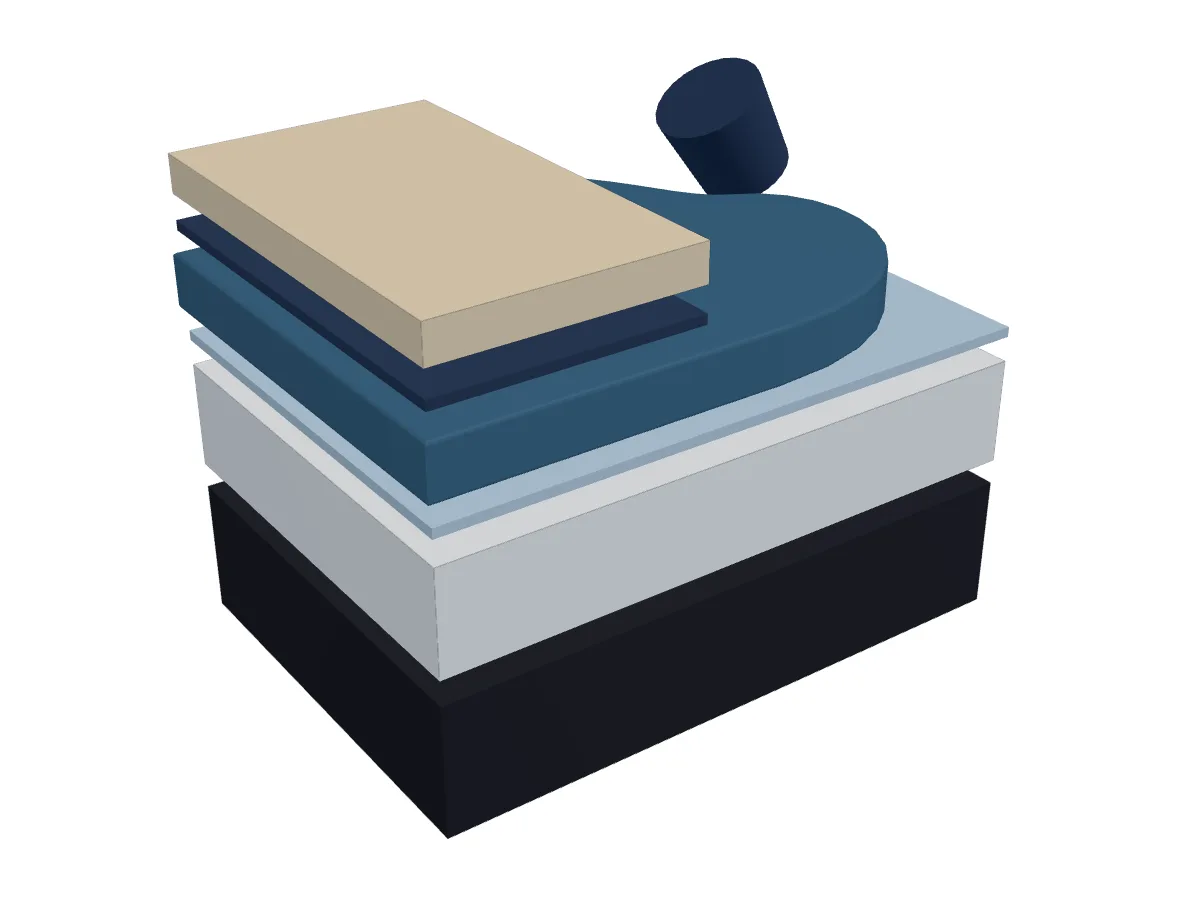
Then the primer, every time. On an absorbent screed a water based acrylic such as Primer G, diluted as its sheet states, or Eco Prim T Plus evens the suction so the compound keeps its water, flows to level and does not pinhole as air escapes the screed. On a non absorbent substrate, existing tile or a resin, a grip primer such as Eco Prim Grip Plus or Pidilite's Paviland Primer Ceramic gives the compound a key. Where the substrate is weak or carries residual moisture, a polyurethane primer such as Eco Prim PU 1K consolidates and seals it. The model shows the primer as the thin layer between screed and compound for exactly this reason: it is what stops pinholes and lets the compound flow.
How thick can a self levelling compound go in one pass?
Three bands cover the stock. Thin finishing compounds run from about 1 to 10 mm and are the usual choice under LVT over a reasonable screed: Ultraplan, classified CT C30 F7, Ultraplan Eco 20, classified CT C30 F7 A2FL S1, Pidilite's Paviland SL 10 at CT C20 F6, and the Weber range on the Weber self levelling line, where weberfloor 4716 and weberfloor Rapid each state their own class and range on the sheet. Thick bed compounds reach 30 to 40 mm where the screed is low or missing: Ultraplan Maxi, classified CT C35 F7, and the fibre reinforced Planex HR Maxi, classified CT C30 F6 A1FL. Thixotropic rapid mortars such as Nivorapid, classified C40 F10, hold their shape for ramps, steps and vertical patches where a flowing compound would run away.
The minimum matters as much as the maximum. Below the minimum the compound loses its water too fast, especially on a hot slab, and the surface is weak and dusty. Above the maximum it cracks as it shrinks. Where more depth is needed than one pass allows, the sheet will say whether to pour twice with a primer between, or to extend the compound with a graded aggregate, or to rescreed with a product such as Topcem Pronto, classified C30 F6, and level on top. The exact range for each product is on its data sheet, and that figure is the one that goes in the specification.

Tap the model to open the layers and compare the 5 mm compound with the 50 mm screed under it; the compound corrects flatness, the screed makes the level, and the primer between them is what stops the pinholes.
Pumped or poured: which suits the job?
Hand pouring means mixing 25 kg bags with a paddle in a tub, pouring, and spreading with a rake and a spiked roller. It suits rooms, corridors and repairs. Pumping means a mixing pump fed from bags or a silo, a hose to the floor and a continuous pour. It suits open floor plates from about a thousand square metres up, gives one water dose for the whole floor, and removes the cold joins between mixes that show under a thin finish. Not every product is pumpable and the data sheet says which are, so the method is chosen with the product, not after it.
Heat decides the hour. On a UAE site the compound is poured early, with cool mixing water, doors closed and direct sun off the slab, because a slab at 40 degrees halves the working time on the sheet and leaves a wet edge that will not knit. The water dose is measured, not judged, because extra water is the fastest route to a weak, dusty surface that a resilient adhesive will not hold.
When does fibre reinforcement matter?
Fibre is specified when the substrate can move or crack under the compound. That means a low strength screed that cannot be removed, an old substrate carrying adhesive residue, a plywood or timber deck, a slab with live hairline cracks, a floor with underfloor heating pipes, an exterior floor that cycles through heat, or a pour at the thick end of the range where shrinkage is highest. Polypropylene or glass fibres in the mix control plastic shrinkage cracking while the compound cures and give the hardened layer flexural toughness, so movement below does not become a crack above that telegraphs through 2 mm of LVT.
Fibre does not rescue a failing substrate. A screed that crumbles under a screwdriver or fails a pull off test is removed and replaced, not levelled over. Over timber the fibre reinforced compound is used with the primer and the mesh or decoupling layer its data sheet specifies, because the board itself moves with humidity. In the Mapei range Planex HR Maxi is the fibre reinforced thick bed product, and the Mapei self levelling line page sets out which others carry fibre. Kerakoll's Keracem and Keracem Pronto are the rapid drying screed route when the decision is to rebuild the screed rather than level a weak one.
What do the CT C F classes under EN 13813 mean on the bag?
EN 13813 is the European standard for screed materials, and the designation on the bag reads in a fixed order. The first letters give the binder: CT is cementitious, CA is calcium sulphate, SR is synthetic resin. C followed by a number is the compressive strength class in N/mm2 at 28 days, and F followed by a number is the flexural strength class in N/mm2. An A class, where it appears, is wear resistance by the Böhme method, where a lower number is better, and the fire class follows, A1fl or A2fl s1 for cementitious products.
Read against the stock: Paviland SL 10 is CT C20 F6, Paviland SL 10R is CT C25 F5, Ultraplan is CT C30 F7, Ultraplan Maxi is CT C35 F7, Nivorapid is C40 F10 and Planex HR Maxi is CT C30 F6 A1FL. The model's generic layer is CT C25 F6, which is the usual minimum written for a compound under a resilient finish. Under LVT and vinyl the flexural figure is the one to watch, because the layer is thin and bends with the substrate rather than being crushed. Under heavy wheeled traffic or a thick bed tile, the compressive and wear figures move up the list. The class is a property of the product, not of the thickness, so the same bag carries the same class at 3 mm and at 10 mm, provided it is within its range.
How long before the finish can go down?
The data sheet gives three times at 23 degrees and 50 per cent relative humidity: when the compound takes foot traffic, usually a few hours; when a tile adhesive can go on, often the next day; and when a resilient or wood finish can go down, which depends on the compound reaching the moisture limit the finish manufacturer sets, usually 75 per cent relative humidity on a hygrometer for a resilient floor. UAE conditions are not 23 and 50: an unconditioned building in summer skins the surface before the compound has cured through, and a conditioned building with no air movement dries slowly. Thicker pours take longer. The compound is protected from direct sun, draughts and traffic for its first day, never water cured, and the moisture is measured, not estimated, before the adhesive is opened.
Where the programme is tight, rapid products such as Nivorapid, Planiprep Fast Track and weberfloor Rapid cut the wait, and the LVT then goes down on an adhesive matched to it such as Ultrabond Eco 4 LVT. Where our sister company Sixty Newton Technical Services LLC lays the compound, the moisture readings and the pour record come with the handover. Materials are supplied from the three branches in Al Quoz, Mussafah and Al Sajaa, and the Mapei brand hub explains how data sheets and the authorisation letter are issued for the submittal.
How many bags for 180 m2 at 6 mm?
Take an open plan office floor of 180 m2 to be levelled at an average 6 mm for LVT.
- Volume factor: 180 m2 × 6 mm = 1,080 m2 mm.
- Rate: the data sheet gives consumption in kg per m2 per mm. To show the arithmetic only, with a nominal 1.6 kg per m2 per mm: 1,080 × 1.6 = 1,728 kg.
- Bags: 1,728 ÷ 25 kg per bag = 69.12, so 70 bags before allowances.
- Allowance: add 5 per cent for the low spots that take 8 mm where the average is 6, and for the mix left in the tub: 1,728 × 1.05 = 1,814.4 kg, ÷ 25 = 72.6, so order 73 bags.
- Primer: 180 m2 at the rate on the primer page, at the dilution its sheet gives for an absorbent screed.
Replace the nominal rate with the kg per m2 per mm on the data sheet of the compound you choose; that figure sets the order, not this example.
What to send us
Send the floor area, the average thickness or the straightedge readings, the substrate type and the finish that follows, or the BOQ line itself, on WhatsApp, and the quotation comes back with compound, primer and the LVT or tile adhesive counted against the data sheets, which arrive with the quote. Trade and project pricing is set up through the trade account.
Questions this guide answers
How thick can a self levelling compound be applied in one pass?
Most cementitious self levelling compounds are applied between 3 and 10 mm in one pass. Thin finishing products can be feathered towards 1 mm at the edge of a repair, and thick bed products reach 30 to 40 mm in one pour. The exact minimum and maximum are on each product's data sheet, and both limits matter: too thin dries out, too thick cracks.
What flatness does LVT need from the floor beneath it?
A resilient finish such as LVT shows every ripple, so the usual requirement is surface regularity SR1 to BS 8204, which is a maximum deviation of 3 mm under a 2 metre straightedge, with no pinholes, trowel ridges or sharp steps. Many LVT manufacturers ask for tighter, so the finish supplier's data sheet is read alongside the compound's before the specification is written.
Does a self levelling compound always need a primer?
Yes, in practice. On an absorbent screed the primer stops the compound losing its water into the substrate, which causes pinholes, a weak surface and poor flow. On a non absorbent substrate such as existing tile or a resin, a grip primer gives the compound something to bond to. The data sheet names the primer and the dilution for each substrate.
When is a fibre reinforced levelling compound needed?
When the substrate can move or crack under the compound: a weak or low strength screed, a plywood or timber deck, a cracked slab, a floor with underfloor heating, or a pour at the thick end of the range. The fibres control shrinkage cracking and give the layer flexural toughness, so a hairline movement below does not telegraph through a thin resilient finish above.
What does CT C25 F6 mean on a levelling compound bag?
It is the EN 13813 designation. CT means a cementitious screed material, C25 means a compressive strength of at least 25 N/mm2 at 28 days, and F6 means a flexural strength of at least 6 N/mm2. Some products add an A class for wear resistance and a fire class. Under a resilient finish the flexural figure matters more than the compressive one.