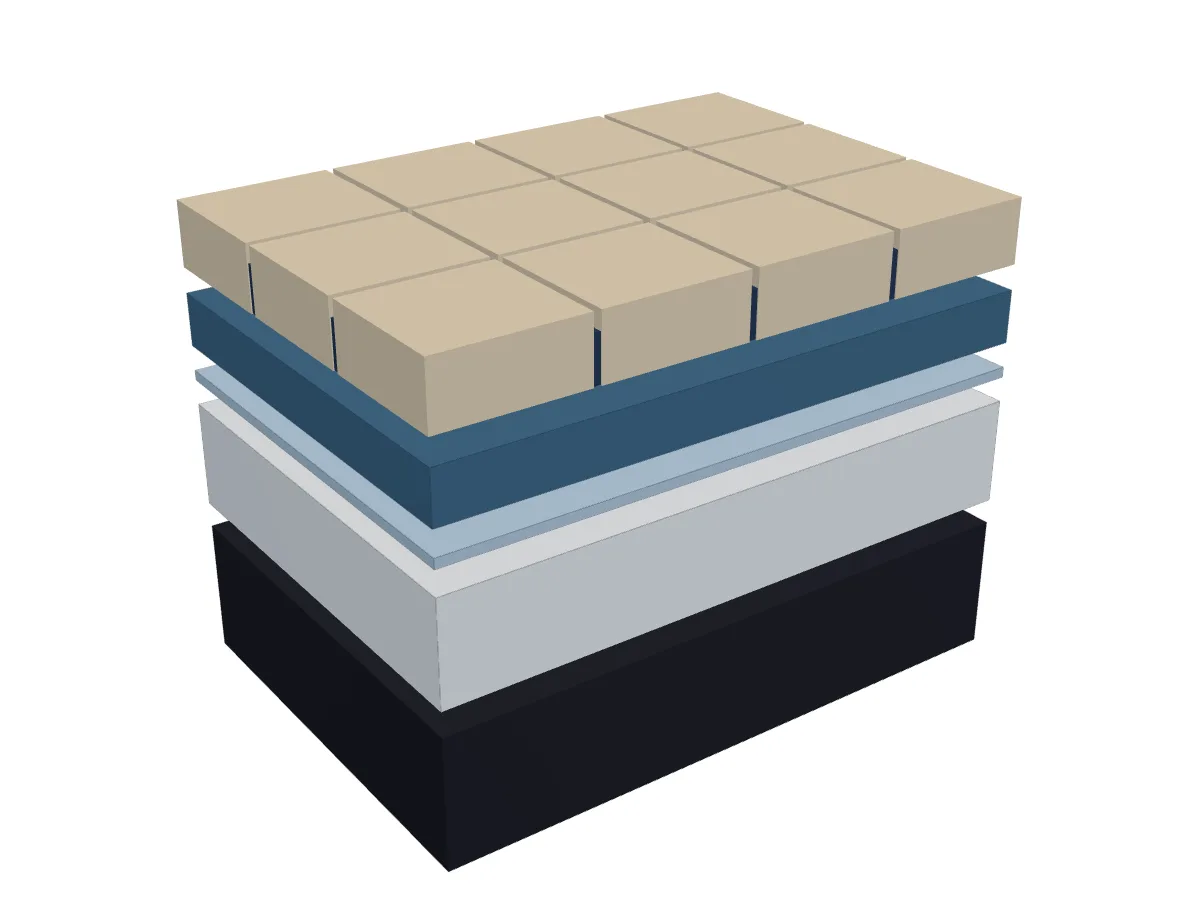
What C1, C2, T, E, F, S1 and S2 mean on an EN 12004 tile adhesive bag, which class suits which job in the UAE, and how to write the class into a specification.
C2 TE S1 is a class under EN 12004, the European standard for tile adhesives. C means cementitious, 2 means improved bond strength of at least 1.0 N/mm2, T means a wall tile will not slip more than 0.5 mm, E means the adhesive stays workable for at least 30 minutes, and S1 means the cured bed can deform by at least 2.5 mm before it cracks. Read together, the string tells a buyer what the bag will do under a tile, and lets a consultant in Dubai or Abu Dhabi write one specification line that any authorised supplier can price against. This guide explains each letter, which class fits which UAE job, and how to specify it.
What do the letters on a tile adhesive bag mean?
EN 12004, and its international twin ISO 13007-1, split tile adhesives into three types by their binder. C is cementitious, a powder mixed with water or with a latex. D is dispersion, a ready mixed paste that is rare on UAE projects. R is reaction resin, usually epoxy or polyurethane, such as Kerapoxy Adhesive at R2T or Keralastic at R2.
The number that follows is the performance class. 1 is normal and 2 is improved, and the test behind it is tensile adhesion strength after curing, after heat ageing, after water immersion and after freeze and thaw cycles.
The letters after the number are optional characteristics. T is reduced slip, E is extended open time and F is fast setting. S1 and S2 are deformability classes tested under EN 12002 and are written after a space. So a bag marked C2 TE S1 is an improved cementitious adhesive with reduced slip, extended open time and S1 deformability. Mapei prints it as ISO 13007-1 C2TE S1 on Keraflex Maxi S1 Zero, Kerakoll prints C2 TE S1 on H40 Gel, and the two bags meet the same requirement.
C1 or C2: what is the difference in bond strength?
A C1 adhesive must reach a tensile adhesion strength of at least 0.5 N/mm2 in every condition the standard tests. A C2 adhesive must reach at least 1.0 N/mm2 in the same conditions, double the figure. The extra strength comes from polymer added to the powder, which also improves the bond to tiles that do not absorb water.
That last point decides the choice on a UAE site. Ceramic wall and floor tiles absorb water, so a plain cement adhesive keys into the back of the tile and C1 is adequate on a stable internal substrate. Products such as Kerabond T at C1T, Keraset at C1 and Pegoland Uno at C1 are priced for that work.
Porcelain absorbs almost nothing, so the adhesive holds by polymer bond alone, and the specification should start at C2. Adesilex P9 at C2TE, webercol Pro at C2TE, Pegoland Dos Plus at C2 TE and H40 Icon at C2 TE are the common choices for porcelain up to 600 by 600 on an internal screed. Anything larger, or anything outside, adds a deformability class, covered below.
What do T, E and F add to the class?
T stands for reduced slip. In the test a tile is bedded on a vertical panel and must not slide more than 0.5 mm. Any adhesive used on a wall should carry T, and the heavier the tile the more it matters. A 600 by 1200 by 10 mm porcelain wall tile at roughly 2,400 kg per cubic metre is worked out like this:
- Face area: 0.6 m by 1.2 m = 0.72 m2
- Volume: 0.72 m2 by 0.010 m = 0.0072 m3
- Mass: 0.0072 m3 by 2,400 kg per m3 = 17.28 kg, call it 17 kg
Seventeen kilograms hanging on a fresh bed will slide on a non slip resistant adhesive before it grabs. The same tile tells you something about bond strength too: its face is 720,000 mm2, and at the C2 minimum of 1.0 N/mm2 the laboratory bond across a full bed is many hundreds of times the tile's weight. The number that fails on site is never the laboratory figure, it is the contact area actually achieved, which is why large format work is back buttered.
E stands for extended open time. A standard adhesive must still bond a tile placed 20 minutes after the bed is combed. An E adhesive must do the same at 30 minutes. In Gulf summer conditions a combed bed skins in a fraction of either figure, so E is the minimum for any work outside an air conditioned enclosure and a sensible default everywhere.
F stands for fast setting, with a tensile adhesion of at least 0.5 N/mm2 after six hours. It suits repairs, night shifts in malls and airports, and any floor that must be grouted and opened the next morning. Adesilex P9 Express at C2FT, Granirapid at C2F S1, Ultralite S1 Quick at C2FT S1 and H40 Advanced at C2F are fast setting lines. Fast set and extended open time pull in opposite directions, so a bag carrying both, such as Pegoland Fastflex at C2FTE S1, has been formulated specifically for it and will state the working window on its data sheet.

Tap the model to open the layers, then select the 6 mm adhesive bed to see where the C2 TE S1 class sits between the primed screed and the porcelain.
S1 or S2: how much deformability does a UAE floor need?
Deformability is tested under EN 12002 by bending a cured strip of adhesive until it breaks. S1, deformable, bends at least 2.5 mm and under 5 mm. S2, highly deformable, bends 5 mm or more.
The bed under a tile has to absorb three movements at once: the thermal movement of the tile face, the drying shrinkage and creep of the screed and slab beneath it, and any live movement of the structure. In the UAE the first of those is large. An external tile face can pass sixty degrees in summer and drop thirty degrees overnight, and a slab under a south facing glass facade is not far behind. The bigger the tile, the more of that movement is concentrated across one piece of adhesive.
The working rule the site uses, and the one the model above is built on, is that 600 by 600 and larger needs S1 under it, back buttered. S1 adhesives in stock at our three branches include Keraflex Maxi S1 Zero, Ultralite S1 at C2TE S1, H40 Gel, Biogel No Limits at C2 TE S1 and Pegoland Flex at C2 TE S1.
S2 is the facade and terrace class, and the class for gauged porcelain panels, tile over timber or metal, and any substrate that moves after tiling. webercol Flex at C2 TE S2, Ultralite S2 Flex at C2E S2, H40 Tech at C2 TE S2 and Pegoland Superflex at C2 TE S2 are the single bag routes. Kerabond T mixed with Isolastic in place of water is the two part route to S2 where the project already holds Kerabond T.
Which class for which job in the UAE?
The table below is the matrix we price most BOQs against. It is a starting point, not a substitute for the consultant's specification or the manufacturer's data sheet.
| Job | Minimum class | Typical products |
|---|---|---|
| Ceramic wall tile up to 300 by 600, internal, dry | C1T or C2T | Kerabond T, Adesilex P7, Pegoland Dos |
| Porcelain floor up to 600 by 600, internal screed | C2 TE | Adesilex P9, Keraflex, webercol Pro, H40 Icon, Pegoland Dos Plus |
| Porcelain 600 by 600 and larger, back buttered | C2 TE S1 | Keraflex Maxi S1 Zero, Ultralite S1, H40 Gel, Pegoland Flex |
| Tile over a waterproofing membrane in a wet area | C2 TE S1 | Keraflex Maxi S1 Zero, H40 Gel, Pegoland Flex |
| Facade, terrace, pool surround, slabs 1200 and above | C2 TE S2 | webercol Flex, Ultralite S2 Flex, H40 Tech, Pegoland Superflex |
| Night works, repairs, fast return to service | C2F S1 or C2FT S1 | Granirapid, Ultralite S1 Quick, Pegoland Fastflex |
| Pools, steel, chemical exposure, tile on non porous tile | R2T | Kerapoxy Adhesive, Keralastic T, H40 Extreme, Pegoland Elastic |
Two cautions. First, the class is a floor, not a ceiling: a C2 TE S1 adhesive is acceptable wherever C2 TE is specified, and pricing the better class across a whole project is sometimes cheaper than holding two bags on site. Second, the adhesive class does not replace movement joints. A facade still needs a joint every three to four metres and an internal floor still needs them at the spacing the specification sets, whatever the S class under the tile.
How do the ANSI classes compare with EN 12004?
American specifications cite ANSI A118 instead of EN 12004. ANSI A118.1 is an unmodified dry set mortar and broadly matches a C1. ANSI A118.4 is a polymer modified mortar and broadly matches a C2. ANSI A118.15 is the improved modified class with higher bond and shear requirements and sits closest to a C2 S1 product. ANSI A118.3 covers epoxy adhesives and grouts and corresponds to the R classes.
Laticrete 254 Platinum is the stock example, classified to ANSI A118.4 and A118.15, and it is the adhesive the UAE buys for porcelain and stone where the project runs on American documents. Some bags carry both systems: webercol Pro lists C2TE and ANSI A118.4, and webercol Premium lists C2TE and ANSI 118.4. The two test regimes are not identical, so do not write "C2 TE S1 or ANSI A118.4" as though they were interchangeable. Cite the system the project is written in and name the acceptable equivalents under the other.
How do you write the class into a specification?
A specification clause for tile adhesive needs six things: the standard, the class, the substrate it is going onto, the bed and trowel, the back buttering rule, and the named product with the submittal it must come with. A clause we see priced cleanly reads like this:
"Tile adhesive for porcelain floor tiles 600 by 600 and larger: cementitious adhesive to EN 12004, class C2 TE S1, applied to a cured, primed sand and cement screed with a 10 mm notched trowel and the tile back buttered to achieve not less than 80 percent contact internally and 95 percent in wet areas. Mapei Keraflex Maxi S1 Zero, Kerakoll H40 Gel or Pidilite Pegoland Flex, or equal approved. Submit the manufacturer's technical data sheet, safety data sheet and the supplier's authorisation letter before ordering."
Written this way, the quantity surveyor prices three authorised brands against one line, the applicator checks the class on the bag, and the consultant verifies the submittal against the clause. The authorisation letters and certificates for the brands we hold are on the credentials page, the full Mapei range is under Mapei tile adhesives and grouts, and the brand hubs for Mapei, Kerakoll, Weber, Pidilite Puma and Laticrete list every adhesive with its class. Contractors and resellers who buy to a specification regularly can open a trade account for project pricing and credit, and the tile adhesive supplier page covers stock and delivery across the three branches.
What to send us: the tile sizes, the areas by location and the substrate, or the BOQ itself, on WhatsApp, and the quotation comes back with the class matched to each area and the data sheets attached. If the specification already names a class, send that line and we price every brand we hold against it.
Questions this guide answers
Is C2 TE S1 the same as ISO 13007-1 C2TE S1?
Yes. EN 12004 is the European standard and ISO 13007-1 is its international twin, and the letters mean the same thing in both. Some manufacturers print the ISO reference on the bag and others print EN 12004, and some run the letters together without spaces. A specification can cite either standard and the same product satisfies it.
Do I need an S1 adhesive for 600 by 600 porcelain indoors?
For 600 by 600 and larger, yes. The larger the tile, the more thermal and drying movement the adhesive bed has to absorb across one piece, and the harder it is to achieve full contact. A C2 TE S1 adhesive, back buttered, is the normal UAE specification at that size. Below 600 by 600 on a sound internal screed a C2 TE adhesive is usually adequate.
Can a C1 adhesive be used for porcelain tiles in the UAE?
Not as a rule. Porcelain has very low water absorption, so the adhesive relies on polymer bond rather than mechanical key, and C1 is tested to only half the bond strength of C2. C1 adhesives such as Kerabond T or Pegoland Uno are for absorbent ceramic tiles on internal walls and floors where the substrate is stable and dry.
What is the difference between S1 and S2 deformability?
Both are measured by bending a strip of cured adhesive until it fails. S1 deforms at least 2.5 mm and under 5 mm, and S2 deforms 5 mm or more. S1 covers large format tiles on screeds and over waterproofing membranes. S2 is for facades, terraces, gauged porcelain panels, and substrates that move, such as timber, metal or lightweight boards.
How does ANSI A118.4 relate to the EN 12004 classes?
ANSI A118.4 is a polymer modified cement mortar standard used in American specifications and broadly corresponds to a C2 adhesive. ANSI A118.15 is a higher performance modified mortar sitting closer to C2 S1 territory. The tests are not identical, so a specification should cite one system and accept the other only as a named equivalent approved by the consultant.